2 Eastman: Textile Sustainability Marketing Practices
Ajoy Sarkar
Case Summary
This case study explores the principles of textile sustainability marketing practices from the perspective of a business leader. Students discover a new branded cellulosic fiber that merges technology, sustainability, and creativity. Ruth Farrell, General Manager for Eastman’s Textile Business, was interviewed for the study. Moreover, an overview of the role of supply chain partners in each part of the sustainability wheel is emphasized.
Learning Outcomes
Upon completion of this case study, students should be able to:
- Define textile recycling
- Describe the challenges and opportunities of textile recycling
- Interpret the important factors of each stage of product development
- Deliberate marketing strategies in the introduction, growth, and maturity of the product life cycle regarding renewable fibers
Introduction
According to Textile Exchange’s 2024 Material Report, the total fiber volume used for apparel, home textiles, footwear, and other fiber applications was 124 million tons in 2023 and is projected to rise to 160 million tons by 2030. A closer look at the numbers shows the continued increase in the share of petroleum-based synthetic fibers, with polyester alone accounting for 57% of total fiber production. It is dishearteningly apparent that the textile industry is not meeting its own stated modest sustainability goals.
Textile-to-textile recycling is an excellent circular route toward achieving sustainability goals because it allows for the use of the same material multiple times. Currently, textile recycling, which includes mechanical, chemical, enzymatic, and molecular technologies, accounts for less than 1% of the global fiber market. Among the barriers to widespread textile recycling are a reliable supply of textile waste feedstock, a strong supply chain for sorting, processing challenges for feedstocks, regulatory hurdles, and, most importantly, firm takeback agreements from brands and manufacturers. However, these obstacles have not dissuaded companies like Eastman, a global specialty materials and innovation company, from developing and investing in cutting-edge technologies for recycling plastics and textiles.
Founded in 1920 as the Tennessee Eastman Corporation to supply raw materials for Eastman Kodak’s photographic business, the company expanded in 1930 to include materials such as textile acetate and cellulosic plastics. Further expansion during the 1950s and 1960s resulted in significant growth and global evolution (see Table 1). Today, Eastman employs over 14,000 people across more than 100 countries and operates 40 manufacturing sites. The company’s corporate headquarters is in Kingsport, Tennessee, with regional headquarters in Rotterdam, The Netherlands, and Singapore. Recognizing that corporate social responsibility (CSR) is crucial in today’s industry practices, the company has made sustainability a core element of its corporate strategy, addressing critical areas such as mitigating climate change, promoting circularity, and contributing to society.
| Financial Metrics (in millions) | 2024 | 2023 |
|---|---|---|
| Net Sales or Total Net Revenue | $9,382 | $9,210 |
| Cost Of Goods Sold (COGS) | $7,092 | $7,149 |
| Gross Margin (GM) | $2,290 | $2,061 |
| Selling, General & Administrative (SG&A) | $736 | $727 |
| Operating Profit | $1,278 | $1,302 |
| Net Profit | $908 | $896 |
| Inventory | N/A | $1,683 |
| Total Assets | N/A | $14,633 |
Check your understanding
- Polyester is the most widely used fiber in the textile industry
- True
- False
- Although textile recycling is true circularity, its widespread success is hindered by:
- Robust collection and sorting protocols
- Regulatory hurdles
- Takeback agreements
- All of the above
- CSR is the guiding principle for most of the companies in the textile and fashion arena
- True
- False
Naia™
Naia™, launched by the Eastman Corporation in 2017, is a sustainable cellulose acetate fiber made in the USA from certified responsibly managed forests in a closed-loop manufacturing process that ensures that the solvents used for fiber formation are recycled back into the system for reuse. The optimized, low-impact process has a low tree-to-fiber carbon and water footprint, utilizing track-and-trace technology to deliver transparency and third-party certifications for credibility. Available in staple and filament forms, the Naia™ staple fiber attributes are softness, quick drying, and reduced pilling. The filament yarn is known for its silky hand, comfort, luxury feel, and ease of care. Naia™ fibers can be blended for various textures, colors, and prints for home and fashion markets such as ready-to-wear, casual wear, knitwear, garment linings, bedding, and towels. In addition to sustainable raw materials and production processes, Naia™ is certified as biodegradable and compostable in the event of fiber leakage into the environment.
Naia™ Renew
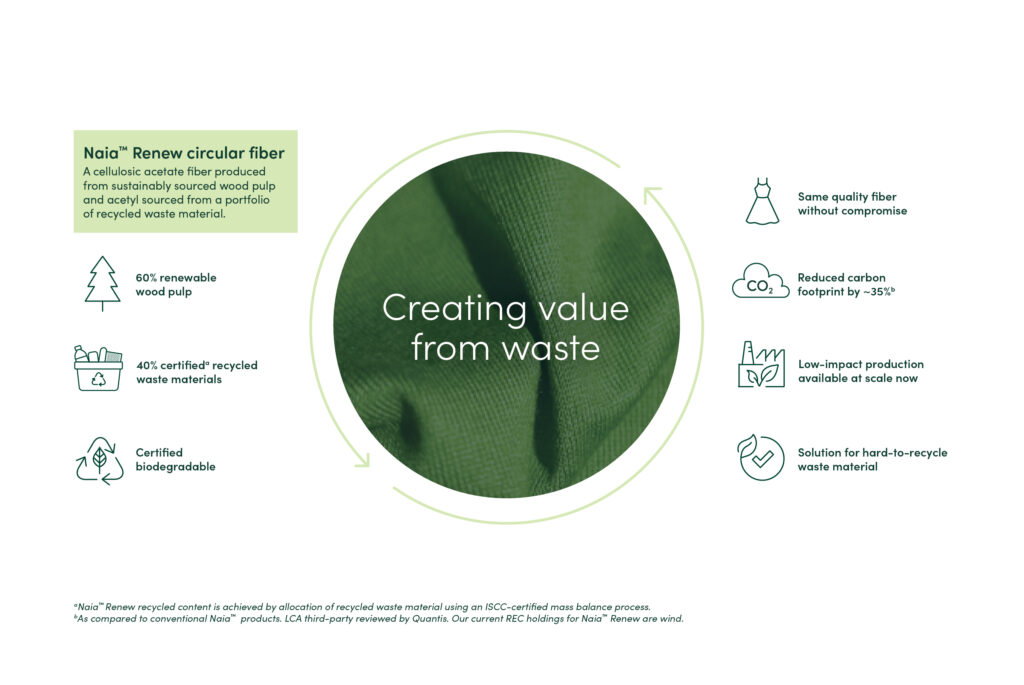
The Naia™ portfolio was expanded in 2020 by introducing Naia™ Renew, a cellulose acetate produced from 60% sustainably sourced wood pulp and 40% certified recycled waste and acetyl (see Figure 1). Naia™ Renew, therefore, creates value from hard-to-recycle waste that would otherwise go into landfills. The raw material feedstock reduces the carbon footprint by approximately 35% without compromising the quality of fiber compared to the legacy acetate fiber.
Naia™ Renew ES
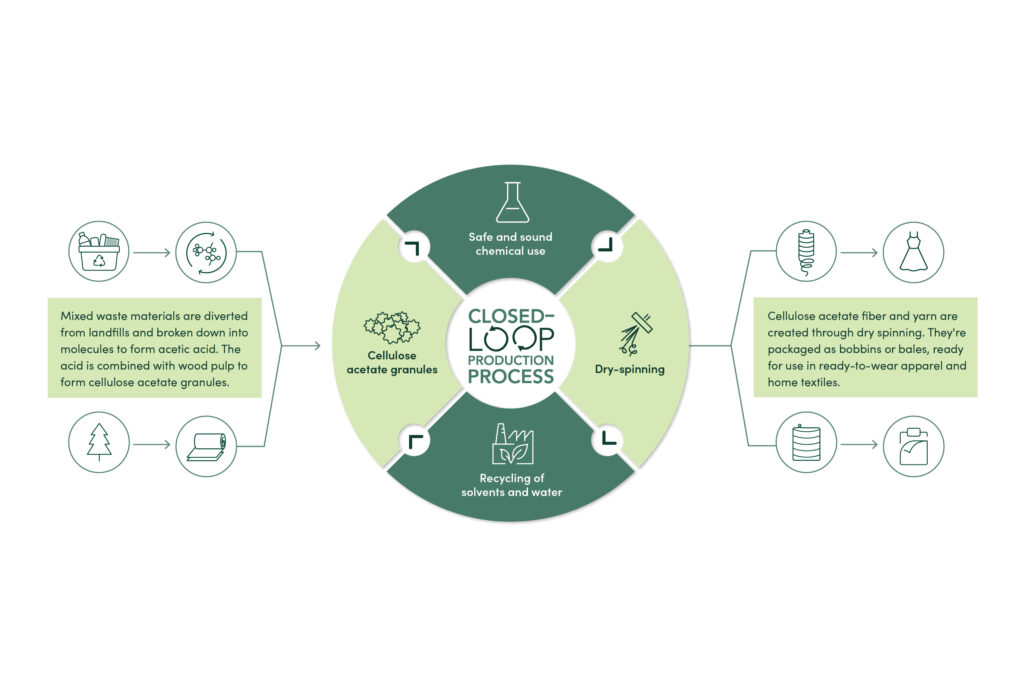
Furthering Eastman’s commitment to reducing the overconsumption of raw materials, the latest product addition in 2022 to the Naia™ portfolio is Naia™ Renew ES (Enhanced Sustainability), made from 40% molecularly recycled waste materials, 20% recycled cellulose, and 40% sustainable wood pulp (see Figure 2). The 20% recycled cellulose comes from non-forest-derived cellulose waste. The 40% acetic acid comes from Eastman’s molecular recycling technology that breaks down the Global Recycled Standard (GRS)-certified recycled waste comprised of pre-and post-consumer carpets and mixed plastics that cannot be mechanically recycled into their molecular building blocks, which are then converted to acetic acid to make cellulose acetate yarn and fiber.
Eastman recently partnered with apparel brand Patagonia to recycle 8,000 pounds of pre- and post-consumer clothing waste, which Eastman processed into new fiber. Debrand, a next-life logistics company, has also collaborated with Eastman to recycle 5,000 pounds of pre- and post-consumer apparel waste.
Product Development and Marketing of Sustainable Fiber – Opportunities and Challenges
Per Ruth Farrell, General Manager for Eastman’s Textile Business, post-COVID-19, there has been a “crystallization of the intentionality around sustainability” abetted by worldwide anticipation for regulation and hope for potential legislation. Eastman works with brands whose approach to sustainability falls in a wide spectrum: (1) brands where sustainability is in their DNA; (2) brands that are driven to adopt sustainable practices in part because of activism from Non-Governmental Organizations (NGOs); and (3) brands that have adopted a wait-and-see approach in anticipation of regulation.
Farrell says that in the last year, brands have accelerated their commitment, but consumers must be educated to elevate sustainability to a different level. Education at the consumer level is challenging because consumers today are bombarded with an avalanche of information, and it is difficult for the average consumer to discern between relevant and false information. In the same vein, Eastman recognizes that students are the future of sustainability and innovation and are actively working with schools to further education and promote a culture of eco-awareness in this area. Currently, they are working with the Fashion Institute of Technology (USA), ESDI Escola Superior de Disseny (Spain), and Donghua University (China).
Education is also important for brands and value chain partners such as spinners, mills, garment manufacturers, and buyers. Towards that end, Eastman has one team working directly with brands and another with spinners and mills. Simultaneously, the company is working to build awareness among designers, R&D teams, and category managers by providing concept fabrics made with Naia™ to demonstrate the versatility of the fiber in terms of the material’s luster, drape, and elegant hand. They also connect brands with different sourcing options worldwide since the industry is globally interconnected. Farrell cautions that without education along the entire supply chain, regulations will have to be the sole yoke for moving the industry toward sustainability.
In discussing product development in the renewable fiber sector, Farrell emphasized the need for companies to maintain a “start-up and scale-up” mode driven by innovation. Fortunately, Eastman has a long history of entering new markets and introducing innovations in materials. Eastman’s sustainable fiber development strategy begins by considering customer needs and collaborating with brand partners while adopting a holistic 360-degree view of sustainability, from sourcing to carbon footprint. When launching new and innovative products on the market, it is crucial to protect the intellectual property rights of all parties involved. Eastman favors a collaborative approach that allows brand partners and collaborators to introduce new products while utilizing confidentiality agreements, trade secrets, contracts, and similar tools to clarify IP ownership. Elaborating on the parameters that determine a product’s success, Farrell states that, ultimately, the most important factor is the product’s viability in terms of profitability. At the outset, the investment might not yield a significant return, but the company must achieve a point where the product becomes cost-effective. Sustainability needs to be commercially viable because only then can sustainable fibers like Naia™ be long-term players in an ecologically conscious industry.
To assure a product’s viability, Eastman employs a five-stage gate process. This management framework features decision points at each phase (gate) of a project. Stakeholders decide whether and how to proceed at each gate. Eastman’s process for Naia includes the following:
- understanding the market needs by using cross-functional teams that monitor innovations starting from early discoveries
- understanding the technical solution
- bringing the first alpha and beta customers on board
- launching the product
- controlling plans to ensure that production volumes are reached at the price points necessary to deliver a profitable product.
Post-launch, there is a rigorous 3-month and 6-month review to evaluate and analyze goals and refine marketing strategies based on market trends and customer needs. The process might not always be a success, but it gives the teams a structure and focus to be as robust as possible.
Branding is an important part of launching and marketing sustainable fibers. Naia™ filament has been successfully branded as an eco-luxury fiber at an affordable price within the mid to high-end women’s ready-to-wear segment. Naia™ staple fiber is suitable for casual wear and knitwear applications. Naia™ fiber is also found in home textiles such as bedding sheets, duvets, and pillow covers. Eastman has trademark licensing agreements with retailers that detail how they may use the brand assets and guidelines for maximizing logos, visuals, and videos to convey a transparent message of Eastman’s story and commitment to sustainability. Brands and retailers adopting Naia™ fiber in their collections include Patagonia, Reformation, H&M, Aritzia, Mango, Banana Republic, COS, Stella McCartney, Naadam, Filippa K, Ivy Oak, Nanushka, and Vince.
A new area for Naia™ fiber is the vast blue denim universe, which Calvin Klein adopted early in China. When entering a new market, it is paramount to understand the value proposition the fiber would bring to the product. For example, most denim fabrics are cotton; therefore, it was important to establish the value of blending Naia™ fiber with cotton in terms of aesthetics as well as functional properties such as comfort, softness, dry feel, breathability, and easy-care characteristics.
Recognizing the challenge of greenwashing present in the marketplace, Eastman and its partners carefully communicate an accurate message to consumers seeking more sustainable products. In addition, the company publicly shares sustainability reports and metrics as external scorecards of its sustainability goals so consumers can trust that the brand is creating a measurable impact toward achieving an ecologically sound industry.
Conclusion
In conclusion, Ruth Farrell shared some final thoughts. Foremost, industry must acknowledge the challenges in the sustainable fibers business. These include scarcity of feedstock, infrastructure for developing circular solutions, investment, and the time it takes to bring the product to market with its associated cost impact. On the other hand, consumer demand for sustainability, while growing, is not at the stage where consumers are actively looking for a sustainable solution whenever they are shopping, nor are they willing to pay a sustainability premium. There is a need to provide value beyond sustainability because sustainability on its own is not enough. Moving forward, the key will be to deliver commercially viable, sustainable fibers with the same quality and durability as traditional fibers but with enhanced design and functional capabilities.
Case Study Discussion Questions
- What are some differences between Naia™, Naia™ Renew, and Naia™ Renew ES sustainable fibers?
- What are the barriers to renewable fiber production and consumer acceptance in the marketplace, and how would you address them?
- Research brands that could gain from collaborations with renewable fiber manufacturers like Eastman. What are the benefits, and how would brands benefit from these partnerships?
- What are some considerations when marketing a sustainable fiber from a consumer perspective, and how can Eastman avoid allegations of greenwashing?
- When developing new sustainable fibers, why is it important to work collaboratively with key stakeholders? Discuss who might be considered Eastman’s stakeholders.
- Conduct a census of textile products made from renewable fibers in your closet. Are you a conscientious eco-shopper? Why or why not?
- What is the market potential for eco-fibers in the next decade?
Glossary
Acetate: Fibers and filaments composed of cellulose acetate as well as yarns, threads, and textile fabrics made from such fibers.
Alpha and beta customers: Early adopters of new products and/or processes.
Carbon footprint: Total carbon dioxide emissions from a product’s life cycle, from fabric manufacturing to the textile product on the retailer’s shelf.
Circular textiles: Fibers produced and designed to be circulated with minimal loss of performance within the production and consumption cycles and subsequently converted to secondary raw materials at the end of their useful life cycle.
Filament: Long fibers. Usually, measured in yards.
Greenwashing: False marketing that makes a product seem more sustainable than it is.
Staple: Short fibers. Usually, measured in inches.
Sustainability: Textiles produced and consumed with minimal environmental impact. May refer to sustainable fibers and materials, sustainable design, sustainable processing, or sustainable use and care of textiles.
Takeback agreements: Program where consumers return used clothing to retailers or brands for recycling.
Textile-to-textile recycling: Process of converting textile waste into new fibers that can be used to create new textile products.
Acknowledgments
Thank you to Ruth Farrell, General Manager for Eastman’s Textile Business, for the interview, and Elyse Batista, Marketing Communications Manager, Textiles, for the images and for reviewing a draft of this case study. Thank you to Susan Watkins for the thoughtful revisions and copy editing.
This research was funded by a State University of New York Innovative Instruction Technology Grant (IITG) administered through the Fashion Institute of Technology (FIT) and in partnership with SUNY Oneonta. The Institutional Review Board at FIT deemed this research exempt from further oversight on October 9, 2024, and there are no conflicts of interest to report.
References
Textile Exchange (2024, September 26). Materials Market Report. https://textileexchange.org/knowledge-center/reports/materials-market-report-2024/
Textile Technology Source (2024, November 11). Advances in Textile Recycling. https://textiletechsource.com/2024/11/11/advances-in-textile-recycling/
Eastman (2024, November 1). Sustainability Reports. https://www.eastman.com/en/sustainability/sustainability-reports
Eastman (2025, January 1). NaiaTM from Eastman. https://www.eastman.com/en/products/brands/naia/sustainability
Eastman (2025, January 1). Applications. https://www.eastman.com/en/products/brands/naia/applications
Eastman (2025, January 1). Certifications. https://www.eastman.com/en/products/brands/naia/sustainability/certifications
Sarkar, A.K., Tortora, P.G., and Johnson, I. (2023). The Fairchild Books Dictionary of Textiles, 9th Edition, New York, NY: Fairchild Books, an imprint of Bloomsbury Publishing Plc.