4 Crate & Barrel Holdings: Building a Home with Purpose through a Modern Leadership Approach
Shelley E. Kohan
Case Summary
This case study examines how Crate & Barrel Holdings, Incorporated (CBH), a home furnishings retailer operating a multi-billion-dollar company growing at 4% annually, has evolved under CEO Janet Hayes’ leadership since 2020. Founded in 1962, the company has transformed from a traditional retailer to a digital-first approach while maintaining its 60+ year heritage of trust and quality. Through strategic investments in technology, employee experience, and service offerings like complimentary design consultations, Crate & Barrel has created a seamless unified experience that emphasizes category dominance in home furnishings, sustainability, and customer-centricity. The company’s modern mindset philosophy focuses on purpose-driven leadership, with initiatives including fully recyclable furniture and enhanced in-store services and experiences. Targeting Gen Z, Millennials, and Gen X consumers with household incomes above $75,000, Crate & Barrel Holdings has successfully differentiated itself through exceptional service and sustainable practices. This transformation positions the company as a leader in sustainable home furnishings retail while demonstrating how heritage brands can embrace digital innovation without compromising core values.
Learning Outcomes
Upon completion of this case study, students should be able to:
- Analyze the specific tactics used by Crate & Barrel Holdings to modernize operations without alienating existing customers to understand how established retail brands can successfully implement digital transformation strategies while maintaining their core identity, brand values, and existing and new customer trust.
- Critique leadership approaches in retail by examining how Janet Hayes’ purpose-driven leadership approach to employee empowerment, customer feedback integration, and sustainability initiatives impacted Crate and Barrel’s organizational culture, employee engagement, and business performance metrics.
- Synthesize the components of effective omnichannel retail implementation, evaluating how digital-first merchandising, physical store optimization, and technology integration create competitive advantages in the modern retail landscape.
- Evaluate customer-centric decision-making by reviewing methodologies for collecting, analyzing, and implementing customer feedback in retail operations, assessing how data-driven approaches to customer experience can drive continuous improvement and business growth.
Introduction
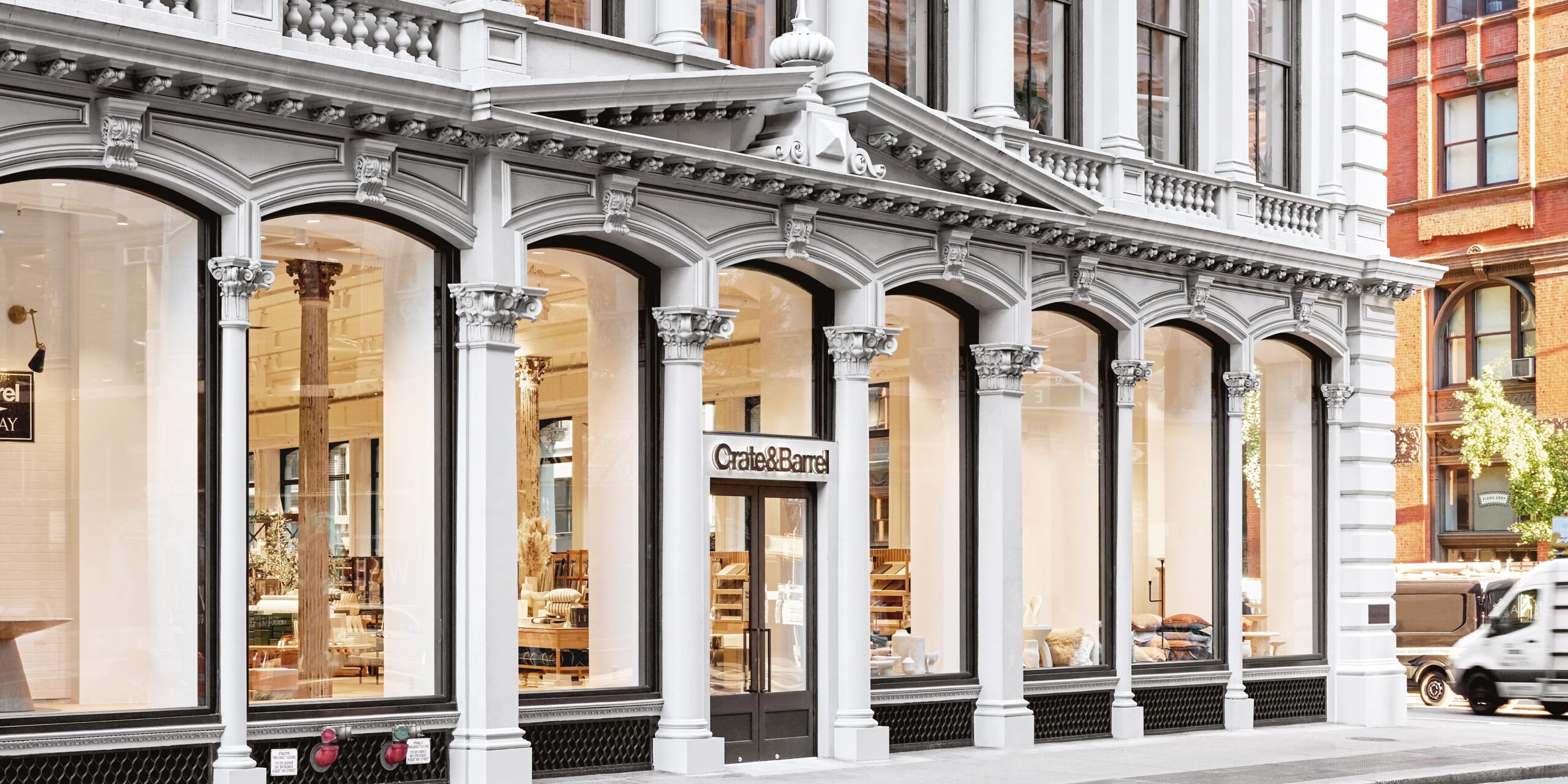
The home furnishings industry represents a $120 billion market in the United States, experiencing steady growth of approximately 4% annually as consumers increasingly invest in their living spaces (U.S. Census Bureau, 2024). This sector has undergone a significant transformation, having been particularly accelerated by the COVID-19 pandemic, which shifted consumer behavior toward online shopping and elevated the importance of home environments. Within this competitive landscape, heritage retailers face the dual challenge of honoring established brand identity while adapting to rapidly evolving consumer expectations and technological capabilities (Home Furnishings Association, 2024).
Crate & Barrel Holdings, Incorporated, founded in 1962 by Gordon and Carole Segal, built its reputation on offering high-quality, modern home furnishings with exceptional customer service. The company’s founding story began with a simple observation: American consumers desired access to the type of contemporary, European housewares the Segals had discovered while on their honeymoon.
The company’s target market consists primarily of Gen Z, Millennials, and Generation X consumers, typically aged 25-45, with household incomes exceeding $75,000. These customers value quality, sustainability, and authentic brand experiences. They represent a demographic that researches purchases extensively online but still appreciates the tactile experience of shopping in physical stores for significant home furnishing investments.
Crate & Barrel Holding’s revenue model combines direct-to-consumer sales through both physical stores and e-commerce, with additional revenue streams from design services, trade, b2b and wedding registry, and the family of brands, including CB2, the contemporary furniture brand, Crate & Kids, the children’s furnishings brand, and Hudson Grace, the elevated gifting brand. The company operates approximately 100 stores across the United States and Canada, plus international locations, generating annual revenues of approximately $2.5 billion.
Leadership Philosophy and Purpose-Driven Transformation
When Janet Hayes became CEO of Crate & Barrel Holdings in 2020, she inherited a respected brand facing the unprecedented challenges of pandemic-driven retail disruption. Hayes recognized that the company needed to adopt what she termed a modern mindset, leveraging the brand’s traditional aesthetic while applying contemporary thinking to operational strategies and customer engagement.

Central to Hayes’s leadership approach is the concept of building a home with purpose. This serves as a North Star, guiding decision-making across all functions, channels, and customer interactions.
This philosophy extends beyond merchandise selection to encompass how products are manufactured, who produces them, and what their environmental impact is throughout the product lifecycle.
During a 2025 interview with Hayes, she explained the importance of this approach: “When you think about purpose, hopefully it’s always relevant, but I will tell you, I feel like it’s more relevant now than ever…for people to find their purpose. And if your home is your purpose, you’re going to be selecting items to go in it that are thoughtful, some things that are built to last, built the right way, meaning right for the Earth.”
This purpose-driven philosophy has translated into tangible business initiatives that differentiate Crate & Barrel Holdings from competitors. The brand has developed innovative products, such as the Revive Sofa, crafted from 99% post-consumer recycled materials and designed for easy disassembly. The fully recyclable sofa demonstrates how sustainability considerations are integrated into product development from conception through the end of the life cycle and embodies the intersection of innovation, comfort, and ecological responsibility.
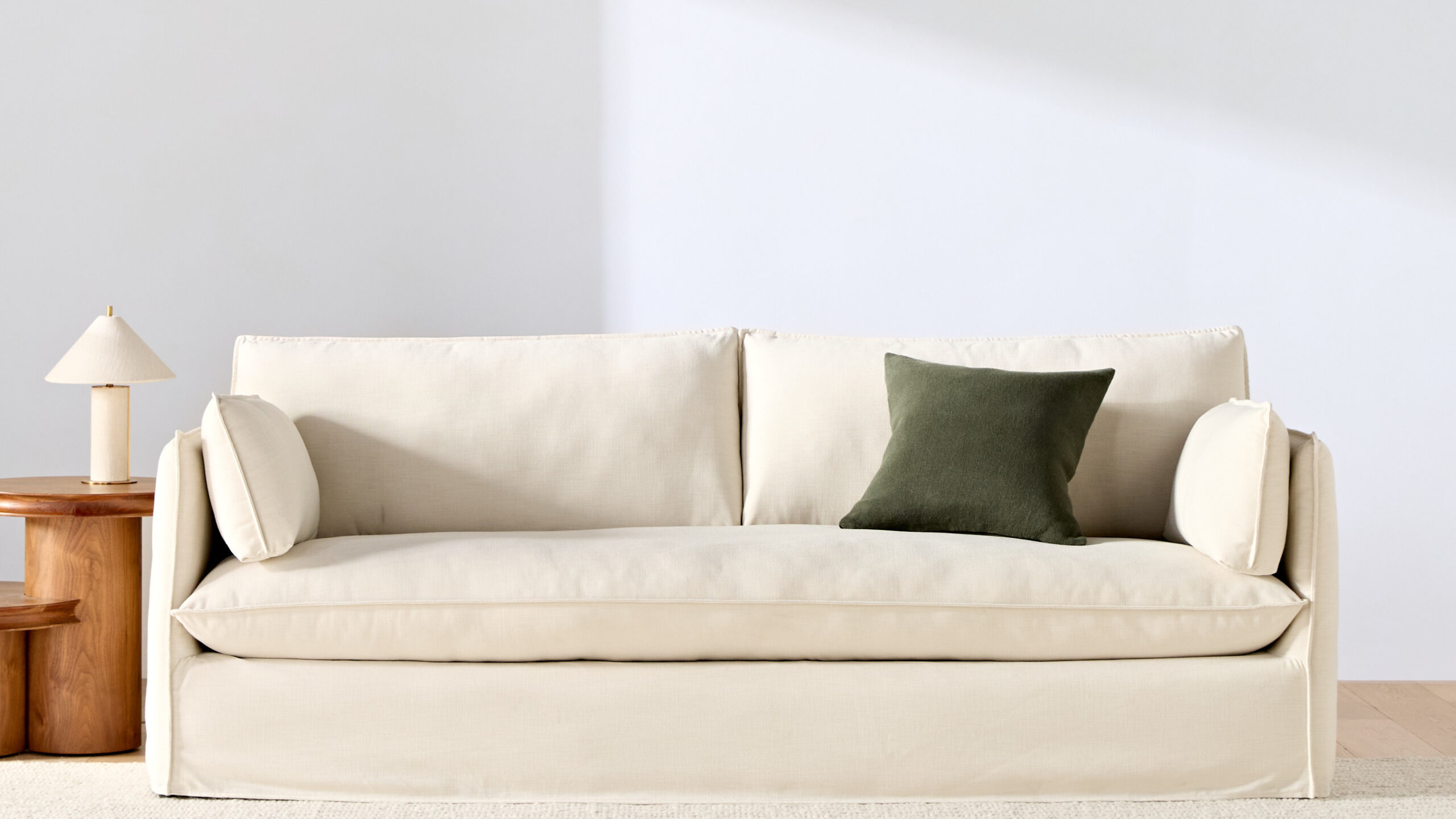
Crate & Barrel Holdings has also increased its emphasis on responsible sourcing, sustainable materials, eco-friendly packaging, and comprehensive product lifecycle planning. These efforts align with consumer preferences for environmentally conscious brands while supporting the company’s long-term brand positioning and market differentiation.
Hayes has simultaneously transformed the organizational culture through her leadership style, consistently redirecting credit to employees and customers while taking personal responsibility for difficult decisions. “At the end of the day, the buck stops with me, but the credit goes to them,” said Hayes. This approach has fostered increased employee engagement and created organizational momentum for growth initiatives.
The leadership transformation has enabled strategic investments in technology, employee experience, and customer service capabilities. By creating a culture of empowerment and accountability, Hayes has positioned the organization to respond more effectively to market changes and customer needs.
Check Your Understanding
- How does Crate & Barrel Holdings’ building a home with purpose philosophy create competitive differentiation in the home furnishings market, and what are the potential risks of this approach?
- Analyze the relationship between Hayes’ leadership style and employee engagement. How might this approach impact customer service delivery and business performance?
- Evaluate the argument in favor of developing a fully recyclable sofa. What are the potential costs and benefits of this sustainability initiative?
- Compare purpose-driven leadership with traditional profit-maximization approaches. Under what circumstances might each approach be most effective?
Digital-First Merchandising and Omnichannel Integration
Crate & Barrel Holdings has fundamentally reimagined its approach to retail by embracing a digital-first merchandising strategy that recognizes the reality of modern consumer behavior.
The company’s research indicates that 90% of customer journeys begin online, typically on mobile devices, before customers visit physical stores or make purchases. Amanda Springer, Executive Vice President of Stores for Crate & Barrel Holdings, explains the consumer behavior influencing this strategy during a 2025 interview: “The vast majority of customers begin their shopping journey on mobile devices. They won’t immediately get up from the couch and drive to a store—they’ll research on their phone, laptop, or desktop first.”
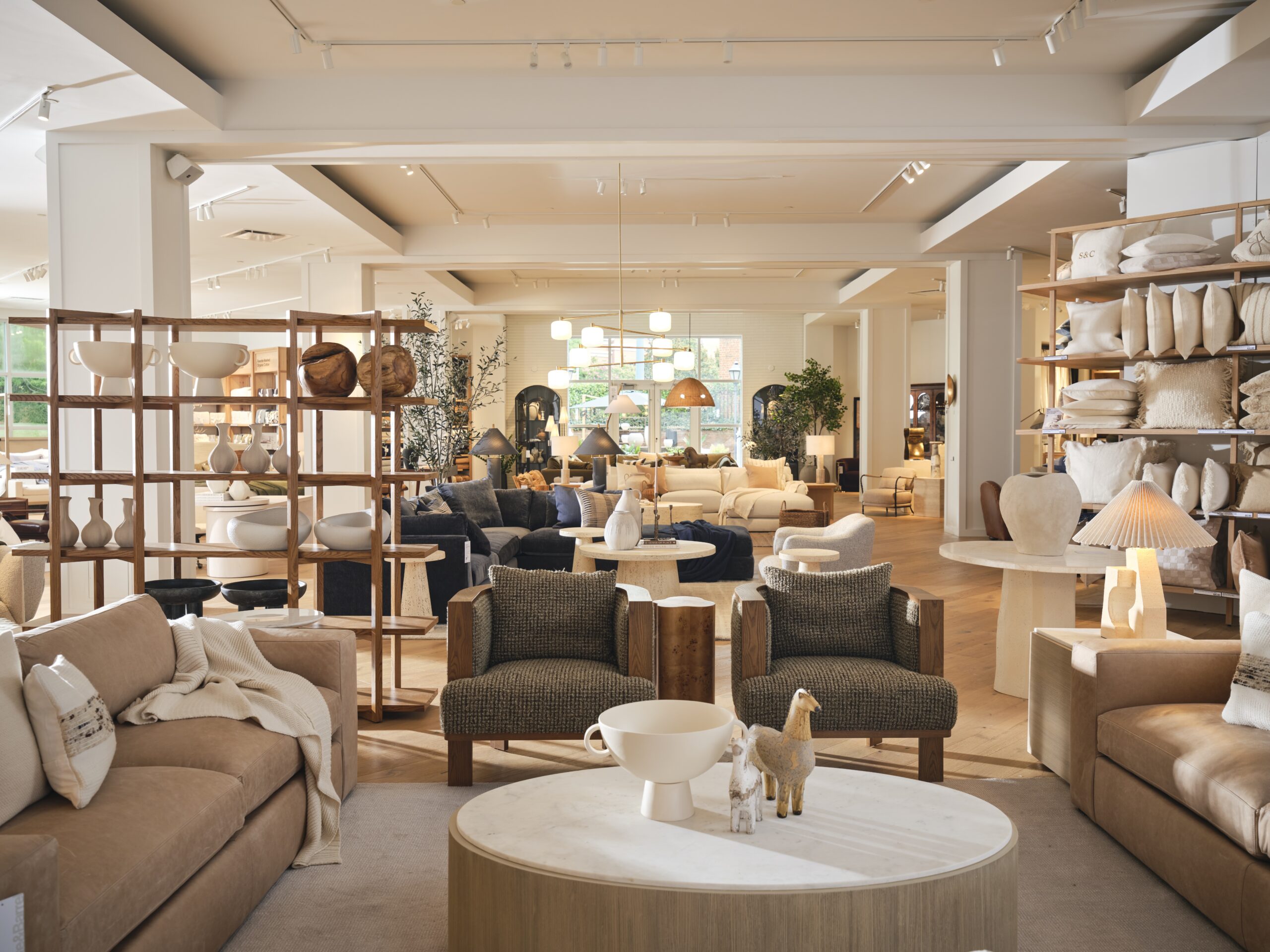
This digital-first approach represents a complete inversion of traditional retail practices. Rather than designing store layouts and then adapting them for online presentation, Crate & Barrel now designs the website experience first, then brings that same visual merchandising strategy to physical stores. The company creates online category landing pages before determining how to manifest that same shopping experience in brick-and-mortar locations.
The transition to digital-first merchandising was not immediate. Hayes notes that the shift began in earnest around 2023, with the pandemic providing an unexpected opportunity to rethink store layouts while locations were temporarily closed. The goal is to create an omnichannel experience, a seamless one-commerce experience where brick-and-mortar and e-commerce operate as complementary channels rather than competing ones.
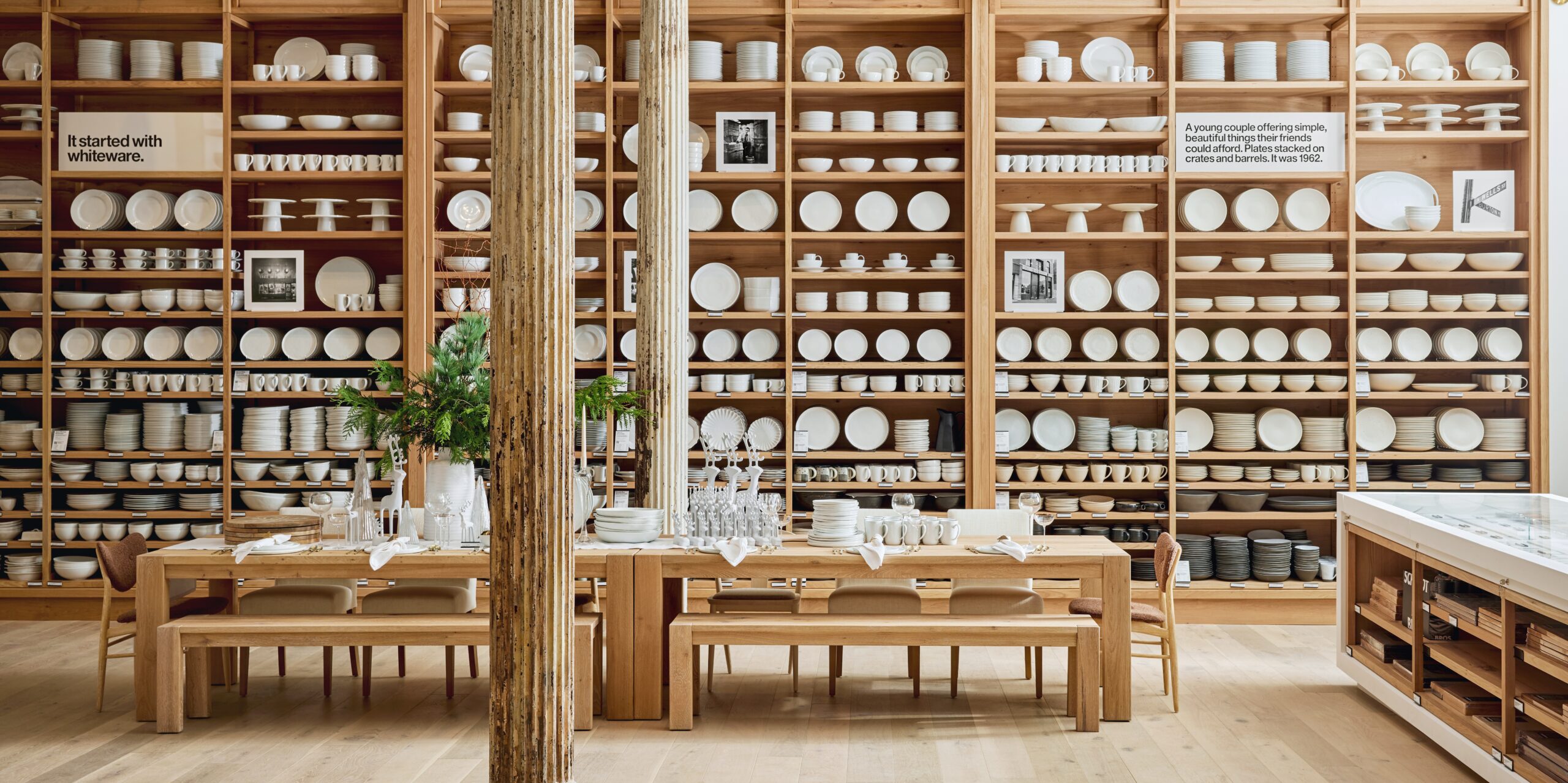
This approach is most visible in category-dominant merchandising displays that mirror how products are organized online. For example, the white ware wall at Crate & Barrel’s Flatiron store in New York creates a comprehensive display that showcases the entire dinnerware and entertaining categories, similar to how a customer would experience it when browsing online. The store layout provides clear visual organization while allowing customers to see all options within a category simultaneously.
The company has also implemented QR code integration throughout stores, enabling customers to access additional product information, customer reviews, and finish options available online but not displayed in-store. This technology facilitates self-service when desired, while still enabling a high level of service and personal interactions with associates when customers seek assistance.
The digital-first approach extends to inventory management and product assortment planning. Store displays are curated to highlight the most popular items from each category, with QR codes providing access to the complete assortment available online. This strategy optimizes physical space while ensuring customers can access the full product range.
Check Your Understanding
- What are the advantages and disadvantages of Crate & Barrel’s digital-first merchandising approach compared to traditional retail strategies?
- How does the one commerce concept address the challenges of channel conflict between online and physical retail?
- Evaluate the role of QR codes in bridging digital and physical shopping experiences. What are the potential limitations of this technology?
- What organizational changes in the company’s hierarchy would be required for a traditional retailer to implement a digital-first approach?
Customer Feedback and Data-Driven Decision Making
One of the most distinctive aspects of Hayes’s leadership approach is her commitment to systematic customer feedback collection and utilization. Each workday begins with Hayes dedicating the first 15 minutes to reviewing customer comments from multiple sources: website feedback, store exit surveys, in-home delivery reports, and customer service interactions.

This daily practice enables Hayes and her team to identify and address issues before they escalate into larger problems. As she explains, “Most of that data is going to tell me why sales performance varies from expectations. The immediacy of this feedback loop allows the company to respond quickly to emerging problems or opportunities.”
Hayes’ approach inverts the traditional customer feedback model, where information typically rises through multiple organizational layers before reaching senior leadership. By personally reviewing feedback daily and following up directly with team members, Hayes demonstrates the importance of customer experience to the organization while creating a culture of accountability for customer satisfaction.
The CEO’s approach extends beyond formal feedback mechanisms to include social media monitoring, with particular emphasis on reading comments rather than focusing solely on engagement metrics. Hayes states, “I’d rather read the comments that are written than stare at the photo that we posted. I read through all the comments, and I can pick up things in there pretty quickly.”
This customer-centric, data-driven approach influences product development, merchandising decisions, and operational improvements. While Hayes acknowledges social media as valuable input, she places greater emphasis on store interactions and website analytics because they provide deeper, more substantive feedback than the brief engagements typical on social platforms.
The company has developed sophisticated systems for tracking customer satisfaction across touchpoints, including delivery experiences, product quality, and service interactions. This comprehensive feedback integration enables the organization to identify patterns, predict potential issues, and implement preventive measures.
Customer feedback has directly influenced major business decisions, including store redesigns, product development priorities, and service enhancement initiatives. The company’s emphasis on listening to customers has contributed to higher customer satisfaction scores and increased customer lifetime value.
Check Your Understanding
- Evaluate the benefits and potential drawbacks of having the CEO personally review daily customer feedback. How might this approach scale as the company grows?
- Compare the value of different customer feedback sources (website reviews, social media, store surveys) for retail decision-making. Why might some sources provide more actionable insights than others?
- Analyze how immediate feedback integration might impact organizational culture and employee behavior throughout the company. How could this influence communication, motivation, and performance across teams?
- What systems and processes would be necessary to implement a similar feedback integration approach in other retail organizations?
Employee Experience and Service Innovation
Under Hayes’ leadership, Crate & Barrel Holdings has made significant investments in employee experience, recognizing that engaged employees deliver superior customer service and drive business performance. These investments encompass technology upgrades, workplace improvements, and expanded professional development opportunities.
The company is implementing new point-of-sale systems, inventory management tools, warehouse technology, and website platforms designed to make employees’ work more efficient and effective. Hayes explains the rationale: “We’re going to give them the most intuitive new system that will save them time, help them be faster, smarter, more informed, and they deserve it.” These technological improvements aim to reduce time spent on administrative tasks, allowing employees to focus more on customer interactions and value-added activities.
Beyond technology, Crate & Barrel Holdings has invested in workplace improvements, including subsidized employee lunches and updated office spaces. Hayes views these investments as essential to supporting employees holistically: “I’m not the person who separates what work is from what it isn’t. I think we have to help employees be their best at work.”
The company has also expanded its service offerings, particularly design services, which Springer identifies as “absolutely our fastest growing service.” This growth has created meaningful opportunities for the company’s workforce by fueling new roles, deepening skill sets, and empowering design associates to build lasting client relationships that go far beyond a single transaction.
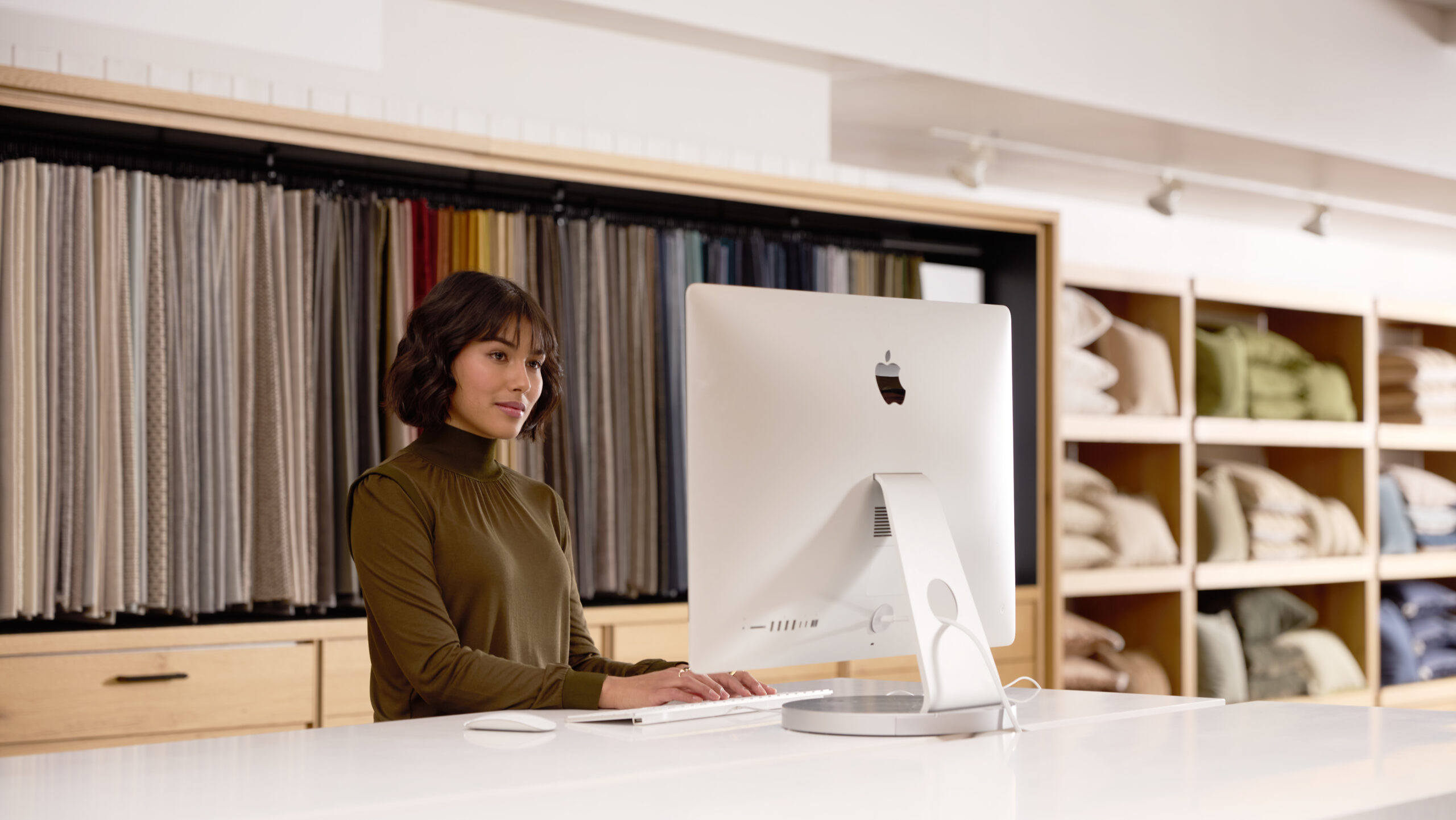
Unlike some competitors who charge fees or require minimum purchase thresholds, Crate & Barrel Holdings offers complimentary design consultations to all customers, regardless of budget or project scope. That accessibility isn’t just good for customers; it gives employees the freedom to engage authentically, without the friction of gatekeeping conversations around cost. This service-forward approach connects to the company’s heritage of exceptional customer service while adapting to contemporary consumer needs.
Product knowledge training has evolved to meet higher customer expectations driven by internet access to information. Associates receive comprehensive education about materials, manufacturing processes, and product features directly from vendors and designers. Springer explains the increased importance of detailed product knowledge: “How that sofa is made is far more important. The materials that are used are far more important. People are asking where the product is made, and we have to be able to say that the amazing sectional is made in North Carolina, and it’s used with this type of wood, this type of glue, this type of fabric.”
Associates are trained on OEKO-TEX and GOTS certified materials, which focus on sustainability and organic integrity of the entire supply chain. The company has also invested in new tools and implemented comprehensive training programs focused on sustainability, environmental impact, and product lifecycle. Employees are educated about the company’s purpose-driven initiatives and equipped to discuss these topics with environmentally conscious customers (Crate & Barrel, 2023).
Check Your Understanding
- Analyze the business case for Crate & Barrel Holdings’ employee experience investments. How might these investments impact customer satisfaction and financial performance?
- Evaluate the decision to offer complimentary design services when competitors charge fees. What are the potential benefits and risks of this approach?
- How has internet access changed customer expectations regarding product knowledge, and what implications does this have for retail employee training?
- What metrics, not mentioned above, could Crate & Barrel Holdings use to measure the return on investment of their employee experience initiatives?
Store Evolution and Physical Space Optimization
Crate & Barrel is strategically rethinking its physical store presence to align with changing consumer preferences while improving operational efficiency. The company is transitioning from larger, multi-level stores (25,000-30,000 square feet) to more compact, preferably single-level locations (16,000-24,000 square feet).
This store optimization extends to back-of-house operations as well. When relocating its flagship store to Flatiron in New York, the company reduced total square footage by about 30% and reduced stockroom square footage by about 40%. These reductions improve operational efficiency while maintaining or enhancing the customer experience.
The company has found particular success with single-floor layouts where customers can see all merchandise categories upon entering, creating a more intuitive shopping experience. Springer explains, “We have found such great success where you go into a single floor, and the customer can walk in and see all the beautiful categories merchandised in a dominant manner.”
Store designs now emphasize category dominance – comprehensive displays of product categories that mirror online shopping experiences. Examples include the white dinnerware wall, glassware displays, and textiles sections, where customers can see the entire assortment at once. These visually striking displays serve dual purposes: they create Instagram-worthy moments that drive social sharing while making shopping more efficient for customers.
Despite reducing store sizes, Crate & Barrel maintains substantial in-store inventory of key items, particularly in glassware and tabletop categories. “Our top-selling glassware, you’re able to walk out with 24 or 48 pieces the same day,” Springer notes. This immediate gratification capability differentiates the company from online-only retailers.
The new store format also incorporates flexible spaces that can be reconfigured based on seasonal merchandise, special events, or changing customer needs. This adaptability allows the company to maximize the impact of its reduced square footage while maintaining visual appeal and functionality.
Store locations are being carefully selected based on demographic analysis, foot traffic patterns, and proximity to the company’s target customers. The company is focusing on high-impact locations in key neighborhoods and shopping destinations with the goal of aggressive store growth in the United States in the next three to five years.
Check Your Understanding
- Analyze the advantages and disadvantages of Crate & Barrel’s move to smaller store footprints. How might this strategy impact customer experience and operational costs?
- Evaluate the concept of category dominance in physical retail merchandising. How does this approach address changing consumer shopping behaviors?
- What role do visually striking, Instagrammable displays play in modern retail strategy, and how might they impact customer behavior?
- How does maintaining a significant in-store inventory of key items support Crate & Barrel’s omnichannel strategy?
The Fully Recyclable Sofa
A Case Study in Purpose-Driven Product Development
One of the most tangible examples of Crate & Barrel Holdings’ philosophy to build a home with purpose is their development of a fully recyclable sofa that can be disassembled and recycled curbside at the end of its useful life. This innovative product represents a fundamental shift in how the company approaches product development, manufacturing, and customer responsibility.

The recyclable sofa project began with a simple question: How can we create beautiful, functional furniture that doesn’t contribute to landfill waste? The development process required collaboration with suppliers, manufacturers, and recycling facilities to ensure that every component could be properly processed at its end-of-life.
The sofa’s design incorporates several innovative features:
- Modular construction that allows complete disassembly without tools
- Clearly marked components for easy sorting by material type
- Sustainable materials throughout, including recycled content where possible
- Packaging made from recycled and recyclable materials
- QR codes that provide customers with step-by-step disassembly instructions
Customer response has been overwhelmingly positive, with the product selling out within weeks of launch. The success has encouraged the company to expand the recyclable furniture line to include additional seating options and storage solutions.
The initiative has also influenced the company’s entire cross-category product development process, with sustainability considerations now integrated into every new product review. This systematic approach to sustainable design reflects Hayes’ commitment to purpose-driven leadership while meeting growing consumer demand for environmentally responsible products.
Case Study Discussion Questions
- Strategic Leadership Analysis: Evaluate Janet Hayes’ modern mindset approach to leadership. How does her daily customer feedback review and employee-focused leadership style contribute to Crate & Barrel Holdings’ competitive advantage? What are the potential risks of this approach, and how might it need to evolve as the company grows?
- Digital Transformation Strategy: Analyze Crate & Barrel’s digital-first merchandising approach. How does this strategy address the challenges of omnichannel retail, and what organizational capabilities would be required for other heritage retailers to implement similar approaches? Consider both the benefits and potential limitations of this strategy.
- Sustainability and Business Performance: Critically assess the business case for Crate & Barrel’s sustainability initiatives, including the fully recyclable sofa. How do these initiatives balance environmental responsibility with profitability? What metrics should the company use to measure the success of purpose-driven product development?
- Employee Experience Investment: Evaluate the relationship between Crate & Barrel’s employee experience investments (technology, workplace improvements, professional development) and business outcomes. How might these investments impact customer satisfaction, employee retention, and financial performance? What evidence would you seek to justify continued investment in these areas?
- Store Format Evolution: Analyze the company’s transition to smaller store footprints and category dominance merchandising. How does this strategy support their omnichannel objectives while addressing changing consumer preferences? What are the implications for real estate costs, inventory management, and customer experience?
- Research and Innovation: Conduct additional research on the home furnishings industry to evaluate how Crate & Barrel Holdings’ strategies compare to competitors like West Elm, Pottery Barn, and Wayfair. What unique positioning does Crate & Barrel Holdings occupy, and how sustainable is its competitive advantage in an increasingly crowded market?
Glossary
Category dominance: A merchandising approach that displays an entire product category comprehensively in one area, allowing customers to see all options at once and creating visually impactful displays that mirror online shopping experiences.
Design services: Complimentary consultations offered by Crate & Barrel to help customers plan room layouts, select coordinating furniture and accessories, and create cohesive home environments.
Digital-first: A retail strategy where online experiences are designed and optimized before physical store layouts, recognizing that most customer journeys begin with digital research and discovery.
GOTS: the acronym for the Global Organic Textile Standard, the world’s leading certification for organic textiles that includes ecological and social criteria.
Modern mindset: Crate & Barrel’s organizational philosophy emphasizes forward-thinking approaches to retail operations, customer experience, and employee engagement while maintaining core brand values of quality and service.
North star: A guiding principle or value that directs company strategy and decision-making.
OEKO-TEX certified: assures safety and environmental friendliness for textile products. The Oeko-Tex Standard 100 is a globally recognized testing system that guarantees textiles are free from potentially harmful substances.
Omnichannel: A retail approach that provides customers with integrated shopping experiences across multiple channels (online, mobile, in-store) with consistent branding, inventory, and customer service.
Point-of-sale systems: Integrated hardware and software solutions that manage sales, inventory, and payments, enabling businesses to streamline operations and analyze data.
Purpose-driven leadership: A management approach that prioritizes values beyond profit maximization, including sustainability, employee well-being, and positive social impact, while maintaining business performance.
QR code integration: The strategic use of scannable codes in physical retail environments to connect customers with digital product information, reviews, and expanded assortment options.
Sustainability: Environmental consciousness integrated into business operations, including responsible sourcing, eco-friendly materials, sustainable manufacturing processes, and end-of-life product considerations.
Acknowledgments
The author would like to thank Janet Hayes, CEO of Crate & Barrel Holdings, and the retail leadership team for their generous participation in this research. Janet’s forward-thinking leadership serves as an inspiration to all who serve in the retail industry.
Amanda Springer, you are a powerhouse, and your time and insights are greatly appreciated. Lauren Gilliam, your excellent scheduling and coordination skills made this case study possible. Lisa Walker, your generous and caring nature during my visit to corporate headquarters was truly appreciated.
Special thanks to Meg Kollar and the team at Zeno Group—I cannot thank you enough for all your work on this project. Margaux Gonyea, I greatly appreciate your support on this relevant project for future generations. Thank you to Susan Watkins for the thoughtful revisions and copy editing. A heartfelt thank you to my former student, case study writer, and genuinely talented next-gen leader with a bright future, Beatriz Tourinho.
This research was funded by a State University of New York Innovative Instruction Technology Grant (IITG) administered through the Fashion Institute of Technology (FIT) and in partnership with SUNY Oneonta. The Institutional Review Board at FIT deemed this research exempt from further oversight on October 9, 2024, and there are no conflicts of interest to report.
References
Crate & Barrel. (2023). Annual sustainability report. Chicago, IL: Crate & Barrel Holdings.
Home Furnishings Association. (2024). Industry market analysis and trends report. High Point, NC: HFA Publications.
National Retail Federation. (2024). Omnichannel retail strategies: Best practices and performance metrics. Washington, DC: NRF Research.
Retail Industry Leaders Association. (2023). Employee experience and customer satisfaction correlation study. Arlington, VA: RILA Publications.
U.S. Census Bureau. (2024). Monthly retail trade survey: Furniture and home furnishings stores. Washington, DC: U.S. Department of Commerce.