3 Sezzle
Scaling a Business as a Fintech Company
Shelley E. Kohan; Beatriz Tourinho; and Bridget Lavery-Palmieri
Case Summary
The buy now, pay later (BNPL) business has seen significant growth throughout the years. The U.S. BNPL market size was valued at USD 1.64 billion in 2022 and is expected to grow at a compound annual growth rate (CAGR) of 24.3% from 2023 to 2030 (Nova One Advisors, 2025). The finance service company, Sezzle, was founded in 2016 within the fintech (financial technology) industry and has become a leading player within the fintech industry. Between 2023 and 2024, Sezzle’s net revenue increased by 70.1%, and its net profit margin increased from 4.5% to 29.0%. Sezzle’s market presence has grown with the introduction of innovations and partnerships like Sezzle On-Demand, WebBank, logo placement on the Minnesota Timberwolves’ jerseys, and collaborations with the Money IQ financial literacy program. As a result of its founder-led leadership style and AI integrations, Sezzle sets itself apart from rivals like Afterpay and Klarna, especially with Gen Z and Millennial customers. It successfully maintains a balance between its profitability and its ability to financially empower its consumers to set itself up for long-term success in the fintech industry.
Learning Objectives
Upon completion of this case study, students should be able to:
- Analyze the relationship between the case organization’s culture and strategic decisions to assess the cultural impact on business performance. Students will integrate cultural analysis with strategic outcomes presented in the case, evaluating how organizational culture has served as a competitive advantage or barrier to the company’s strategic objectives
- Critique the leadership effectiveness demonstrated in the case by comparing the leader’s style, traits, and decisions against established leadership theories. Students will systematically evaluate the company leader’s approach using autocratic, democratic, and laissez-faire frameworks; assess their traits against effective leadership characteristics; and judge their performance using transformational leadership principles.
- Synthesize insights from the case analysis to recommend alternative strategic and leadership approaches for improved organizational performance. Students will integrate their analyses of the following concepts: competitive advantage, company culture, leadership effectiveness, and strategic decisions to propose evidence-based recommendations that address the case organization’s challenges and opportunities.
Introduction

Ecommerce in the United States has grown 231% from 2014 through 2024 (U.S. Census Bureau, 2025), opening up a new market for fintech companies. Sezzle Inc. has become one of the leading players in the fintech space, empowering future generations financially. The company has developed a platform where consumers can responsibly spend their money through interest-free installments online and in select in-person stores. Sezzle’s Buy Now Pay Later strategy has been immensely successful, with 2.7 million active consumers using the service. Sezzle’s main target market has been within the Canadian and American regions. Committed to transparency and financial strength, Sezzle has experienced significant growth since its founding in 2016, having attracted new consumers who were debt-averse.
By the end of 2014, credit card debt in the United States had reached $700 billion, and by the end of 2024, the debt increased to an all-time high of $1,211 trillion (New York Fed, 2025). In an economy where credit debt has rapidly worsened, Charlie Youakim and Paul Paradis envisioned developing Sezzle to provide consumers with a flexible payment option.
In a short time, the company has achieved remarkable success among its target audience: Gen Z and Millennials. Sezzle offers shoppers a four-installment payment plan, paying 25% of the total purchase price upfront, with the remaining amount due in three separate installments spread over six weeks. Since Sezzle does not charge interest to the consumer, merchant fees serve as its primary source of income rather than interest charged to customers. Merchants benefit from increased sales, higher conversion rates, and larger average order values, while consumers enjoy more accessible financing options without traditional credit checks and the risk of building high credit card debt.
Scaling the Business
Strategic scaling has been crucial to Sezzle’s success. What began as a pay-by-pay, a flexible per-payment compensation system, offering digital debit with rewards quickly transitioned into a BNPL model. Executive Director and CEO Charlie Youakim, who was named the University of Minnesota’s entrepreneur of the year in 2025 due to his visionary leadership style, believes that much of the business’s growth stems from expanding without necessarily increasing operating expenses. Youakim likens the company’s growth to a weight loss journey where the success lies in both diet and exercise. “A lot of companies don’t focus on the diet; they just focus on exercise. And we’re focusing on both,” said Youakim. The positive growth of Sezzle was attributed to keeping expenses in line while driving revenue increases.
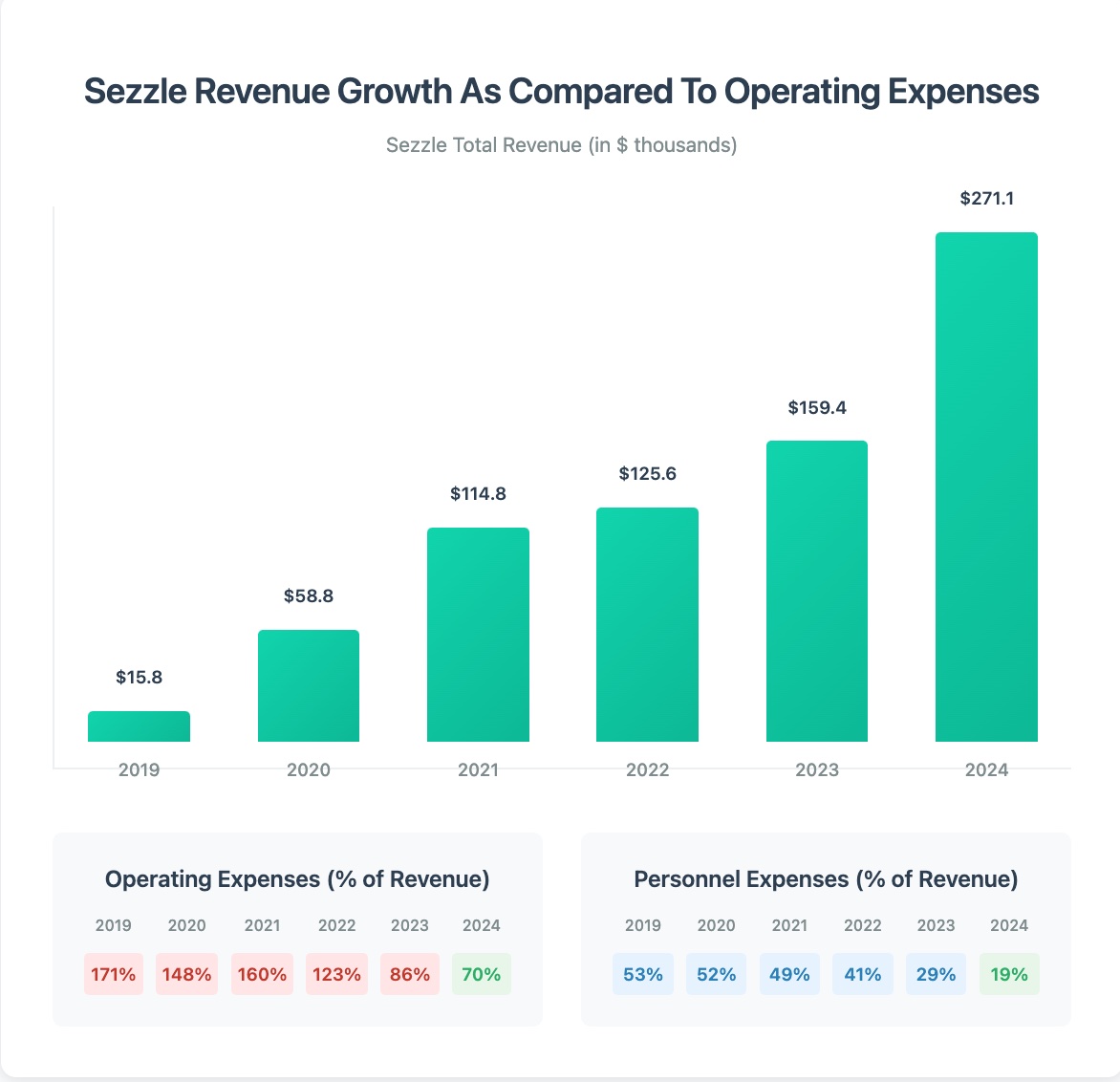
The financial data reflects this new direction. Compared to 2023, the company reduced all of its expense percentages in 2024, which helped increase profit percentages. From 2023 to 2024, Sezzle’s net revenue experienced a 70.1% increase, driven by its innovative initiatives and customer subscription growth. Overall, its return on assets (ROA) demonstrated a 23% improvement, highlighting how well the company utilizes its resources to drive profits.
Since 2022, the company has focused on team restructuring. This has allowed the company to concentrate on both profitability and improved team performance. Personnel expenses as a percentage of total revenue dropped significantly from 41% in 2022 to 19% in 2024, these reductions were part of a broader initiative to optimize overall operating expenses. Additionally, the management team addresses its scaling challenges and can adapt to the market requirements. For example, while technology infrastructure is relatively easy to scale, acquiring new capabilities like AI and machine learning requires hiring specialized talent and represents significant scaling hurdles. When the company makes decisions about team restructuring, it makes sure they have the right talent to support the business as it diversifies its product offerings.
Efficiency and communication are key for Sezzle. Having a fintech business model necessitates both technological infrastructure and human talent; expertise among their employees is essential for continuous improvement and the creation of new features. Sezzle’s service is unique, and strategic planning is vital to deliver its service at the right time with continued development. They have emphasized the importance of constant innovation during service rollouts and partnerships to sustain steady growth. Communication is essential for achieving the objectives; cross-functional communication enables the company to structure its plans through regular meetings at all levels to ensure consistency.
Sezzle’s decision-making process centers on a core team of executives that meets consistently in an open, trust-based environment, supported by broader operational meetings and constant feedback loops throughout the organization. “As Lee Brading, Chief Revenue Officer of Sezzle, explained, “There’s a core group of us that meets three days a week—me, Charlie, Paul, and Amin (chief operating officer). We discuss anything and everything in a very open format. It’s a good trust circle where there’s no politics.” This collaborative approach enables leadership to make well-informed, cross-functional strategic decisions.

Leadership Models
Different leadership styles shape how decisions are made, how teams communicate, and how innovation happens. Match each leadership style to the type of action or decision a leader with that style would take.
Autocratic: A leadership style where one person makes all decisions with little to no input from others, maintaining strict control over operations and processes.
Democratic: A leadership style that involves team members in decision-making processes, encouraging participation and input from multiple stakeholders before reaching conclusions.
Laissez-faire: A leadership style characterized by minimal direct supervision, where leaders provide resources and support but allow team members significant autonomy in decision-making and task execution.
Transformational leadership: A leadership style that inspires and motivates followers to exceed their self-interests for the greater good of the organization, focusing on creating positive change, fostering innovation, and developing followers into leaders themselves.
Which Leader Would…
- Trust the tech team to develop new AI tools independently?
- Make a quick decision about restructuring without consulting employees?
- Encourage the team to innovate financial tools that empower consumers and align with their mission?
- Ask team members for feedback before launching a new technology feature?
Check Your Understanding
- In what ways do you think Youakim’s weight-loss journey analogy and approach to scaling Sezzle demonstrate strategic thinking and adaptability? In what ways would this be considered innovative?
- Based on the case study, would you characterize Youakim’s leadership style as more autocratic, democratic, laissez-faire, or transformational? Provide evidence for your assessment.
- How does Sezzle’s approach to team restructuring (for example, reducing the staff by 200 employees) reflect strategic management decisions? Based on the case study, discuss how strategic business decisions are made and how this helps when scaling a business.
- What does the history of operating and personnel expense as a percent of sales tell you about the company’s strategy (see Graphic 1)?
Partnerships
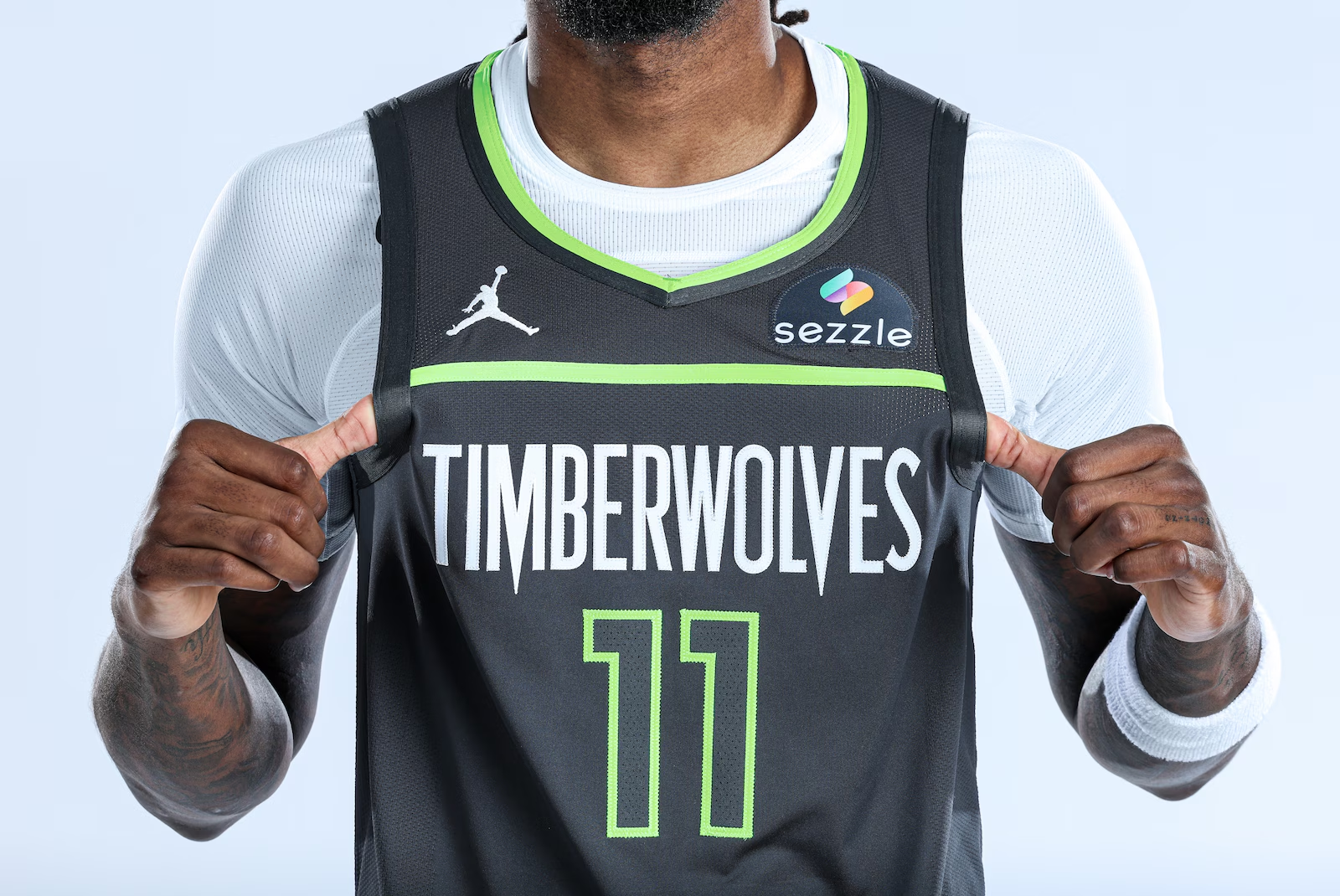
Strategic partnerships and collaborations with Timberwolves, WebBank, and Money IQ have led to developments that showcase the company’s leadership in integrating fintech with a seamless shopping experience, assisting customers in maximizing their savings, and reinforcing the brand’s mission of empowering people financially. For example, the addition of Sezzle’s logo on the Minnesota Timberwolves jersey has enabled Sezzle to enhance its brand awareness. The Timberwolves’ demographics align with Sezzle’s target market; therefore, the partnership allowed Sezzle to expand its merchant network and customer base. Financially, the logo placement increased operational income. From a leadership perspective, it demonstrated Sezzle’s commitment to offering the best for its customers in a transparent and flexible environment, as reflected by strategic alliances and innovation. The 2024 collaboration strengthened its brand positioning and increased brand awareness within the market, solidifying its presence in the fintech landscape.
Sezzle is also striving to provide its customers with more services. Its latest partnership in 2024 with WebBank has created opportunities to enhance customer loyalty through increased financial flexibility by providing more services for the Sezzle users. The most recent launch was Sezzle On-Demand, a non-subscription option that allows Sezzle users (customers) to utilize single-use virtual cards for pay-as-you-go transactions with U.S.-based businesses accepting Visa. With no ongoing costs and a one-time service charge, this option enables customers to obtain interest-free installments while staying within their budget. This increases conversion rates and fosters customer loyalty. Additional advanced features have also been introduced, including AI-driven shopping, which simplifies the discovery of millions of curated products in its product marketplace through features such as price comparisons, price and deal alerts, and auto-couponing. The benefits of the partnership may include the launch of future consumer products, including checking accounts, cash advances, and credit-building products.
Sezzle has also collaborated with Zogo, a financial literacy platform, to develop a product in the Sezzle App, Money IQ that helps users control their finances. Money IQ allows customers to learn about financial literacy through interactive short lessons on the app. The bite-sized modules covering essential financial topics were developed based on the National Standards for Personal Finance Education. These modules aim to empower users with practical knowledge. Completing these lessons comes with Sezzle Spend rewards that can be applied to future Sezzle purchases, encouraging individuals to develop better money management practices. This initiative supports Sezzle’s central goal of helping users make responsible, informed financial decisions and demonstrates the company’s dedication to closing the financial literacy gap, especially among younger generations.
Check Your Understanding
- Why would a fintech company like Sezzle partner with an NBA team?
- How did Sezzle’s partnerships transform its business model?
- How do its partnerships reflect Sezzle’s leadership strategy for innovation, brand-building, and empowering consumers with financial literacy tools?
- What leadership qualities are necessary to achieve such partnerships successfully?
Corporate Culture at Sezzle
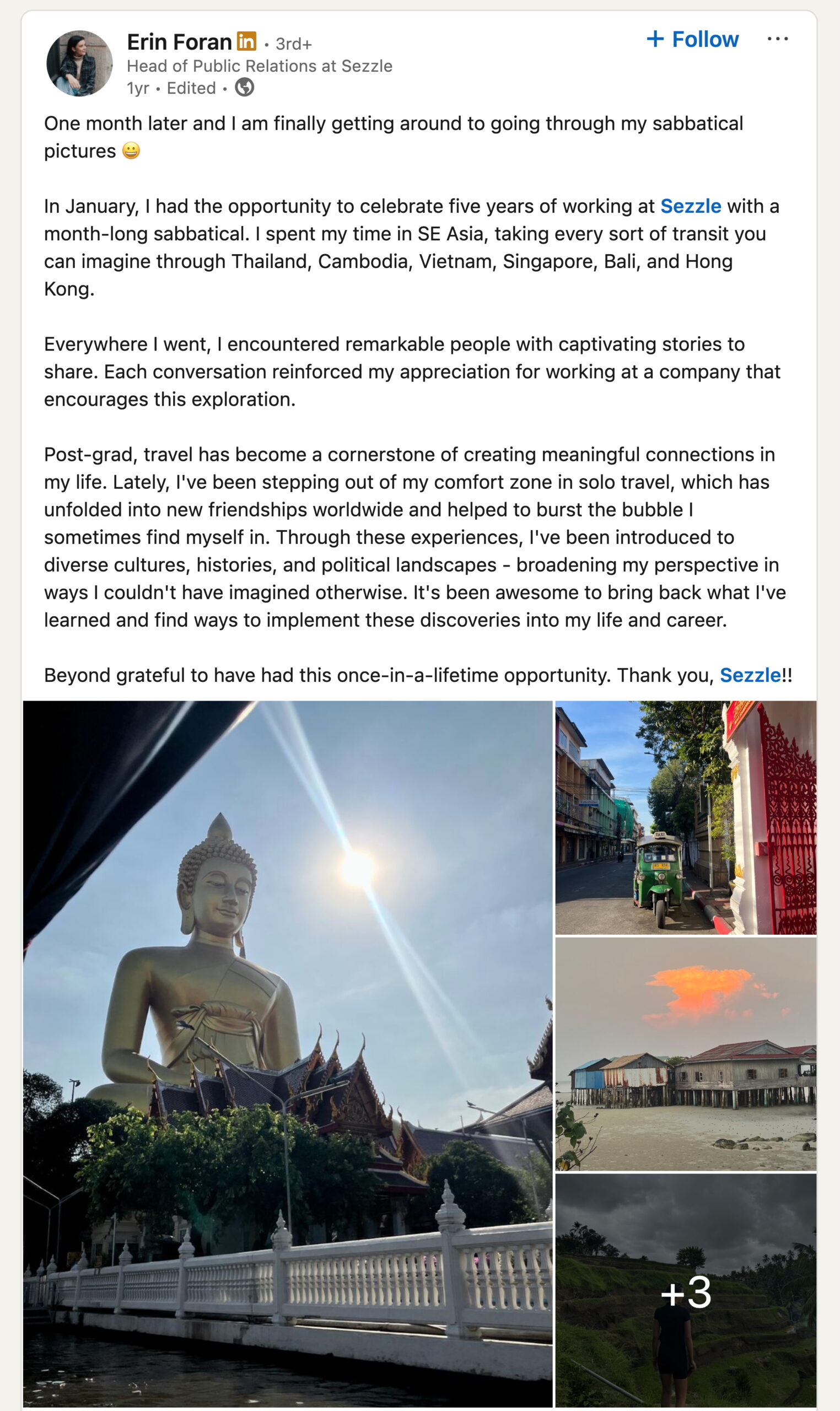
Sezzle recognizes the significance of its employees and their well-being. To reward employees with over five years of service, it has implemented sabbaticals, providing one month of paid leave. Employees are encouraged to fully disconnect from work to pursue whatever they believe is best for their well-being, personal growth, and fresh perspectives. Cultivating a bond with employees through interpersonal, humanistic management fosters a better working environment that benefits every aspect of the company. Erin Foran, head of public relations, had been with the company for six years when she decided to take a month-long sabbatical in Southeast Asia.
Competitive Landscape
The diverse range of innovative products offered on Sezzle’s platform represents its key competitive advantage over market competitors such as Afterpay, Klarna, PayPal, and Zip. The company closely monitors its competition to learn how to enhance and differentiate its products. A strong Net Promoter Score (NPS) in 2025 illustrates that they meet and exceed customer expectations, resulting in satisfied and loyal customers, thereby establishing a virtuous cycle. The founder-led leadership philosophy, which prioritizes efficiency, communication, partnerships, and employee empowerment, has propelled Sezzle into a growth cycle. Sezzle’s competitive edge in leadership encompasses creativity, direction, delegation, coordination, and collaboration.
Financial Analysis
| Financial Metrics (in thousands) | 2024 | 2023 |
|---|---|---|
| Net Sales or Total Net Revenue | $271,128 | $159,357 |
| Cost of Goods Sold (COGS) | $51,364 | $39,208 |
| Gross Margin (GM) | $219,764 | $120,149 |
| Selling, General, & Administrative (SG&A) | $11,403 | $8,588 |
| Operating Profit | $82,246 | $22,200 |
| Net Profit | $78,522 | $7,098 |
| Inventory | N/A | N/A |
| Total Assets | $298,372 | $212,645 |
| Financial Indicator Formula Reference |
2024 | 2023 |
|---|---|---|
| Net Sales (Revenue) | $271,128 | $159,357 |
| a. Cost of Goods (cost of sales) percentage
COGS $/ Net Sales $ |
18.9% | 24.6% |
| b. Gross margin percentage
GM $/ Net Sales $ |
81.1% | 75.4% |
| c. SG&A expense percentage
SG&A $/ Net Sales $ |
4.2% | 5.4% |
| d. Operating profit margin percentage
(Operating profit $/ Net Sales $) |
30.3% | 13.9% |
| e. Net profit margin percentage
(Net Profit $/ Net Sales $) |
29.0% | 4.5% |
| f. Inventory turnover
COGS/Inventory |
N/A | N/A |
| g. Asset turnover
Net Sales $/ Total Assets $ |
0.9 | 0.7 |
| h. Return on assets (ROA)
percentage Net Profit Margin% * Asset Turnover |
26.3% | 3.3% |
Check Your Understanding
- Sezzle’s revenue increased from approximately $159 million to $271 million between 2023 and 2024. Calculate the percentage increase and explain what this rapid growth might indicate about Sezzle’s market position and business strategy.
- The case study shows Sezzle achieved gross margins of 75.4% in 2023 and 81.1% in 2024. How do these margins compare to typical retail industry benchmarks? What factors might explain how a fintech company like Sezzle can achieve such high margins?
- Analyze the significant improvement in Sezzle’s Return on Assets (ROA) from 3.3% in 2023 to 26.3% in 2024. What specific factors contributed to this improvement, and what does this indicate about the company’s operational efficiency?
- Unlike traditional retailers, Sezzle does not report inventory turnover. Why would this metric be marked as “N/A” for a fintech company, and what alternative metrics might better evaluate Sezzle’s operational efficiency?
Case Study Discussion Questions:
- What leadership qualities are most important when guiding a company through rapid industry changes and technological innovation?
- Reflecting on Sezzle’s strategic growth, leadership decisions, and innovative approach, what key leadership lessons can you take away from this case?
- If you were in a leadership role at Sezzle, what action or solution would you implement to ensure long-term success in a rapidly evolving fintech landscape?
- Research the current status of the buy-now-pay-later market. How has the business grown (competitors, BNPL consumer usage levels, other services offered). Based on the current state of the fintech space and specifically BNPL, what strategies could be considered for growth and process optimization?
Glossary
Buy now, pay later: A payment method that allows consumers to purchase goods or services immediately and pay for them in installments over time, typically without interest if payments are made on schedule.
Cross-functional decision making: A collaborative process where representatives from different departments or functional areas participate together in making strategic choices, ensuring diverse perspectives and expertise are considered before reaching important business decisions.
Fintech: A short name for the financial technology industry, referring to the use of technology to deliver financial services.
Financial literacy: The knowledge and skills needed to understand and effectively manage personal finances, including budgeting, investing, debt management, and financial planning.
Net Promoter Score: A metric that measures customer loyalty and satisfaction by asking customers how likely they are to recommend a company’s product or service to others, typically scored from 0 to 10.
Operating expenses: The ongoing costs required to run a business on a day-to-day basis, including rent, utilities, salaries, marketing, and other expenses necessary for normal operations.
Personnel expenses: The total costs associated with employing staff, including salaries, wages, benefits, training, recruitment, and other employee-related expenditures.
Acknowledgements
Thank you, Charlie Youakim, CEO of Sezzle, for your enthusiasm for helping to empower the financial literacy of the younger generations and for being so gracious with your time to help students over the many years and interviews. Thank you to Paul Paradis, President, and Lee Brading, CRO, Sezzle, for the interviews and time to help build a relevant case for students. A especially hearty thank you to Erin Foran, head of public relations at Sezzle, for her amazing efficiency, support, and willingness to help coordinate all of the logistics required for the case study. Thank you to Susan Watkins for the thoughtful revisions and copy editing.
This research was funded by a State University of New York Innovative Instruction Technology Grant (IITG) administered through the Fashion Institute of Technology (FIT) and in partnership with SUNY Oneonta. The Institutional Review Board at FIT deemed this research exempt from further oversight on October 9, 2024, and there are no conflicts of interest to report.
References
Goel, S. (2022, October 25). How does Sezzle work and make money: Business model. The Strategy Story. https://thestrategystory.com/2022/10/25/how-does-sezzle-work-and-make-money-business-model-competitors/
Kohan, S. E. (2020, October 20). Sezzle at FIT, an interview (video) with Charlie Youakim, CEO Sezzle.
Kohan, S. E. (2024, August 13). NBA Timberwolves and Sezzle: A local partnership with national impact. Forbes.com. https://www.forbes.com/sites/shelleykohan/2024/08/12/nba-timberwolves-and-sezzle-a-local-partnership-with-national-impact/
New York Fed. (2025, June 4). Credit card debt in the United States from 4th quarter 2010 to 1st quarter 2025 (in billion U.S. dollars) [Graph]. Statista. https://www-statista-com.libproxy.fitsuny.edu/statistics/245405/total-credit-card-debt-in-the-united-states/
Pymnts (2024, August 28). WebBank to Serve as Sezzle’s Exclusive Bank. Pymnts. https://www.pymnts.com/buy-now-pay-later/2024/webbank-to-serve-as-sezzles-exclusive-bank/
Sezzle. (2025, January 14). Sezzle unveils Money IQ: An interactive rewards program promoting financial education. GlobeNewswire. https://api.kscope.io/ks-doc-view?key=f7ffcb3f-03c2-11ee-acee-0ed29589fc89&content=benznews&docid=90b5e93054b308fe3b0f67949f172be39118441f
Sezzle (2025, March 10). Sezzle announces six-for-one stock split and $50 million stock repurchase program. GlobeNewswire. https://www.globenewswire.com/news-release/2025/03/10/3040160/0/en/Sezzle-Announces-Six-for-One-Stock-Split-and-50-Million-Stock-Repurchase-Program.html
Sezzle (2025, March 12). Sezzle redefines the shopping experience with new features for smarter spending. GlobeNewswire. https://www.globenewswire.com/news-release/2025/03/12/3041518/0/en/Sezzle-Redefines-the-Shopping-Experience-with-New-Features-for-Smarter-Spending.html
Sezzle (2024). Sezzle Annual Report. Sezzle. https://investors.sezzle.com/fr-ca/financials/annual-reports/
Sezzle (2023). Sezzle Annual Report. Sezzle. https://investors.sezzle.com/fr-ca/financials/annual-reports/
Sezzle (2022). Sezzle Annual Report. Sezzle. https://investors.sezzle.com/fr-ca/financials/annual-reports/
Sezzle (2021). Sezzle Annual Report. Sezzle. https://investors.sezzle.com/fr-ca/financials/annual-reports/
Sezzle (2020). Sezzle Annual Report. Sezzle. https://investors.sezzle.com/fr-ca/financials/annual-reports/
Sezzle (2019). Sezzle Annual Report. Sezzle. https://investors.sezzle.com/fr-ca/financials/annual-reports/
TradingView. (2025, February 27). Sezzle Inc. SEC 10-K report. *TradingView*. https://www.tradingview.com/news/tradingview%3A57b863c55de10%3A0-sezzle-inc-sec-10-k-report/
U.S. Census Bureau. (2025). E-commerce sales [Data set]. https://www.census.gov/econ/currentdata/?programCode=MARTS&startYear=1992&endYear=2025&categories[]=44X72&dataType=SM&geoLevel=US&adjusted=1¬Adjusted=1&errorData=0