1 Brand Heat for Sneakerheads
A Case Study in Exclusive Allocation at PUMA Select
Sarah Portway
Case summary
This case study introduces Scott Saltzman, strategic account manager for PUMA Select, and outlines PUMA’s strategy to attract premium sneaker collectors, commonly referred to as sneakerheads. First, the study describes how PUMA categorizes its merchandise into regional business units (RBUs), including the design direction and its general distribution strategies. Next, the study will define allocation, highlight two potential strategies, and explain why PUMA limits the quantity and number of retailers that carry PUMA Select’s most innovative, expensive, and rare sneakers. After reading each case study section, students will complete assignments based on the material they have read, conduct independent research, and create a fashion forecast and allocation plan.
Learning Outcomes
Upon completion of this case study, students should be able to:
- Describe the categories PUMA uses to differentiate merchandise.
- Characterize sneakerheads and predict upcoming trends that will entice them.
- Use critical thinking, sales results, and customer preferences to allocate limited merchandise.
- Communicate research, fashion forecasting, and allocation decisions persuasively in a variety of formats.
Introduction
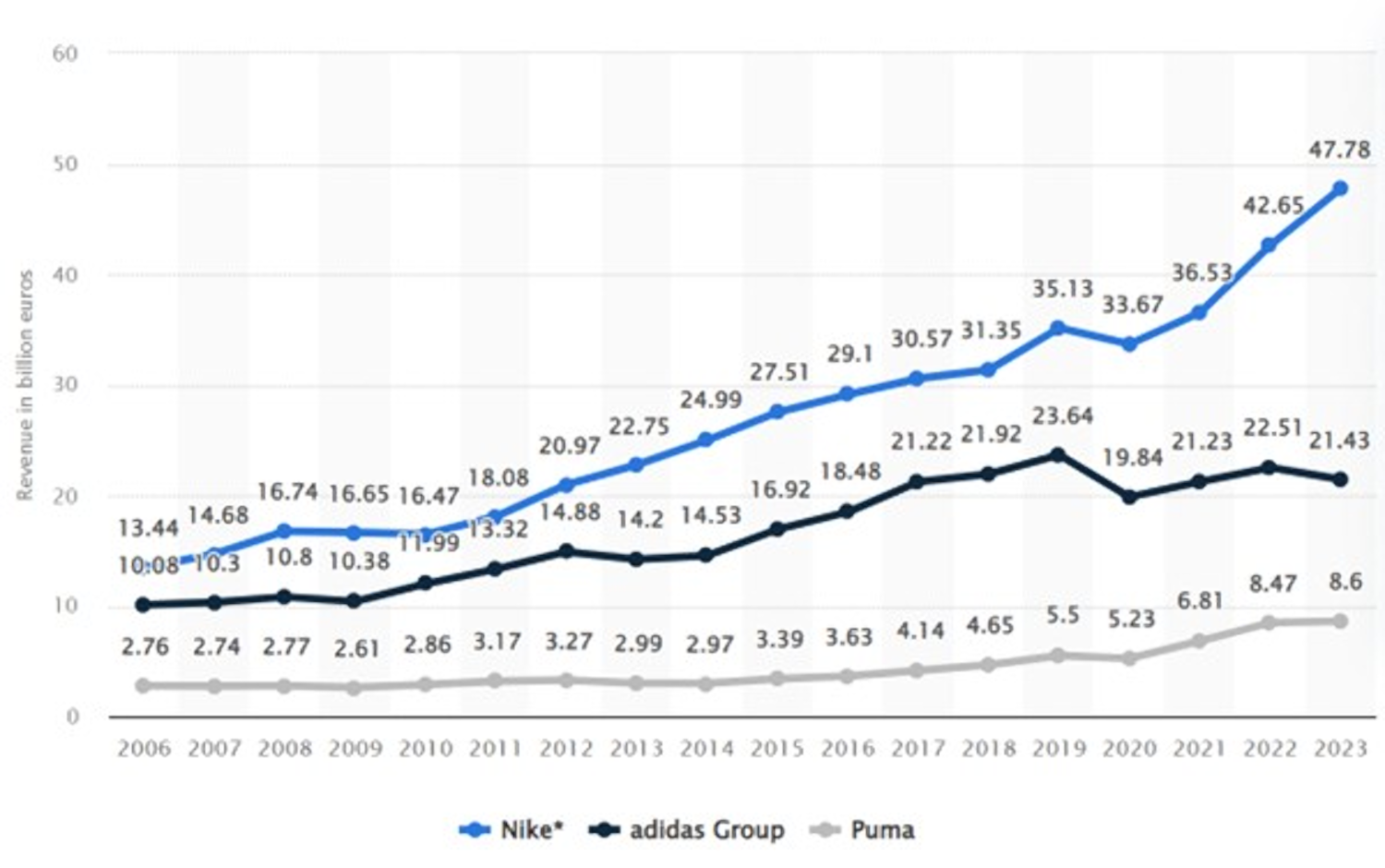
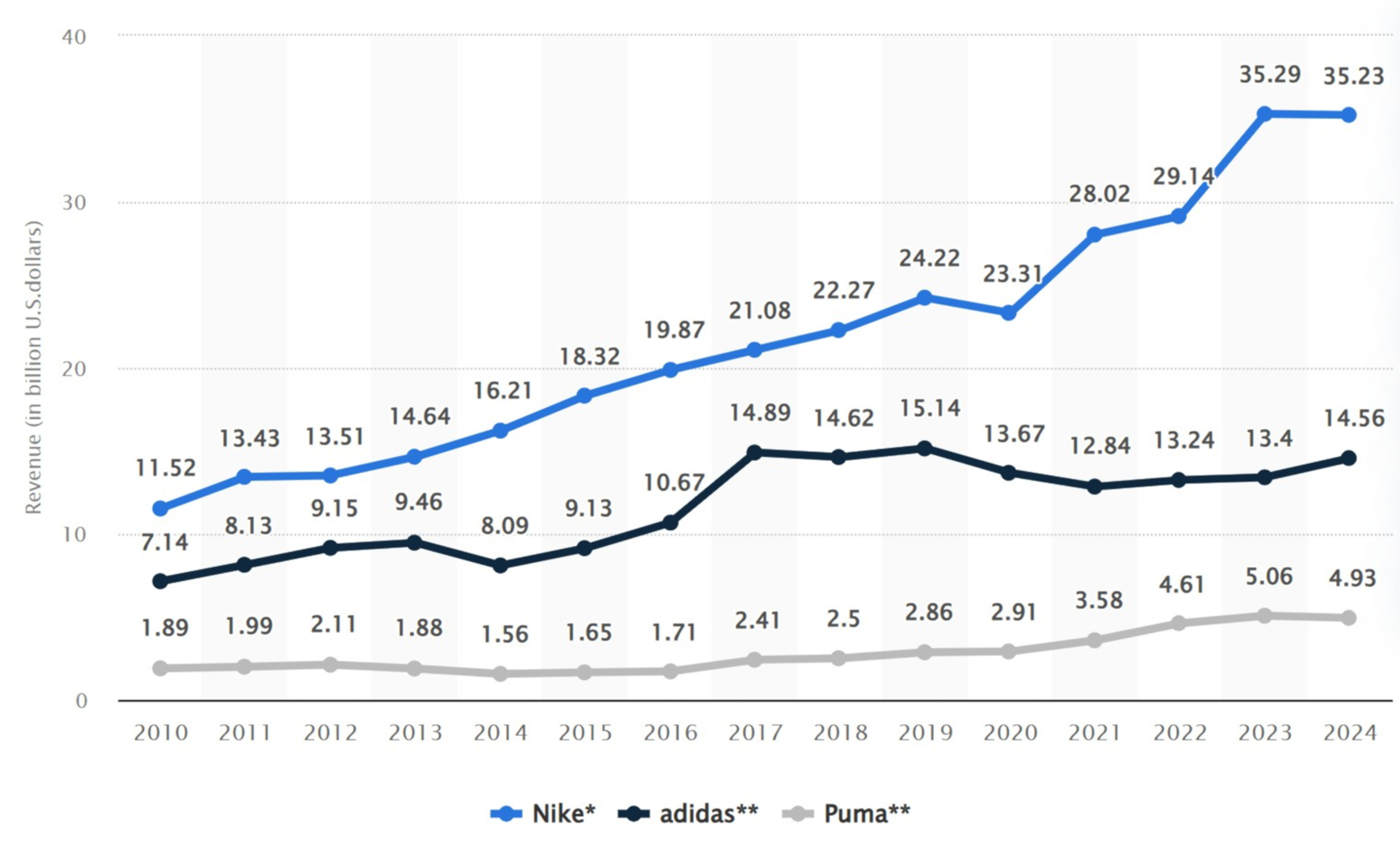
PUMA is an athletic shoe and apparel company headquartered in Herzogenaurach, Germany, with corporate offices and retail locations worldwide. PUMA’s annual revenue has grown steadily, and in 2024, total revenue increased by 4.4% to €8.8 billion, equivalent to approximately USD 10.2 billion (PUMA, 2025a). PUMA is a self-described big cat, but it competes in a field crowded with behemoth competitors, including its German rival, adidas, and America’s Nike. Each brand has multiple product segments, including apparel, footwear, accessories, sports team uniforms, sporting equipment, and more. Figure 1 illustrates Nike’s significant lead in total global revenue across all product segments since 2006; however, there have been signs of shifting tastes in footwear. A closer look at the footwear segment alone, between 2010 and 2024, shows that demand for Nike shoes may be leveling off after a period of rapid growth, as shown in Figure 2. Increasing competition is a factor with up-and-coming brands like HOKA and On presenting formidable threats in the sportswear market. The rate of growth for the two brands was similar from 2022 through 2024, with HOKA’s total revenues reaching USD 2.5 billion (Deckers Brands, 2025), and On reaching USD 2.8 billion (On, 2025). However, in the first quarter of 2025, HOKA’s revenue growth slowed to only 10%, and On saw 43% growth (Takanashi, 2025). HOKA focused on international expansion, while On focused on innovation, fashion-forward details, and expanding its product segments beyond shoes, leading Lei Takanishi at The Business of Fashion to attribute this shift largely to innovation and aesthetics (2025). If Takanashi’s assertion is correct, then PUMA is in an excellent position to grow because they have “… carved a niche by avoiding direct competition with these giants, instead targeting urban fashion enthusiasts” (Mann, 2025, para. 4), as this study will describe.
PUMA’s strategy to gain market share among young fashion enthusiasts is multifaceted. For example, Footwear Magazine reported that PUMA produces 43% of its new footwear from sustainable materials. This shift in production has won favor with climate-conscious Gen Z customers. The brand has also commissioned a new content-creation army of 15,000 micro-influencers to promote PUMA on social media (Mann, 2025). Furthermore, 60% of the research and development budget has been dedicated to their footwear segment in recent years, and the company attributes a 31% drop in return rates in 2024 to its new Nitro Foam midsole technology (Mann, 2025). Rather than casting a wide net and saying very little about each of the ways that PUMA is trying to build excitement with young fashion-forward consumers, this case study will focus primarily on PUMA’s selective distribution strategy for its most innovative and fashion-forward sneakers, describing how PUMA has harnessed the trickle-down effect to attract coveted sneakerhead customers.
To this end, Scott Saltzman, a strategic account manager for PUMA Select, was interviewed in June 2025 to gain a deeper understanding of an insider’s perspective on distribution strategies for the premium sneaker market. Saltzman graduated from the State University of New York at Oneonta in 1986 with a Bachelor of Science in business economics. From there, Saltzman gained sales experience in the fashion industry, working with brands such as Giorgio Armani, Calvin Klein, and Donna Karan. He joined PUMA in 2010, where he became an expert in the premium sneaker market, making him an excellent source of wisdom for this case study.
PUMA’s regional business units (RBUs)
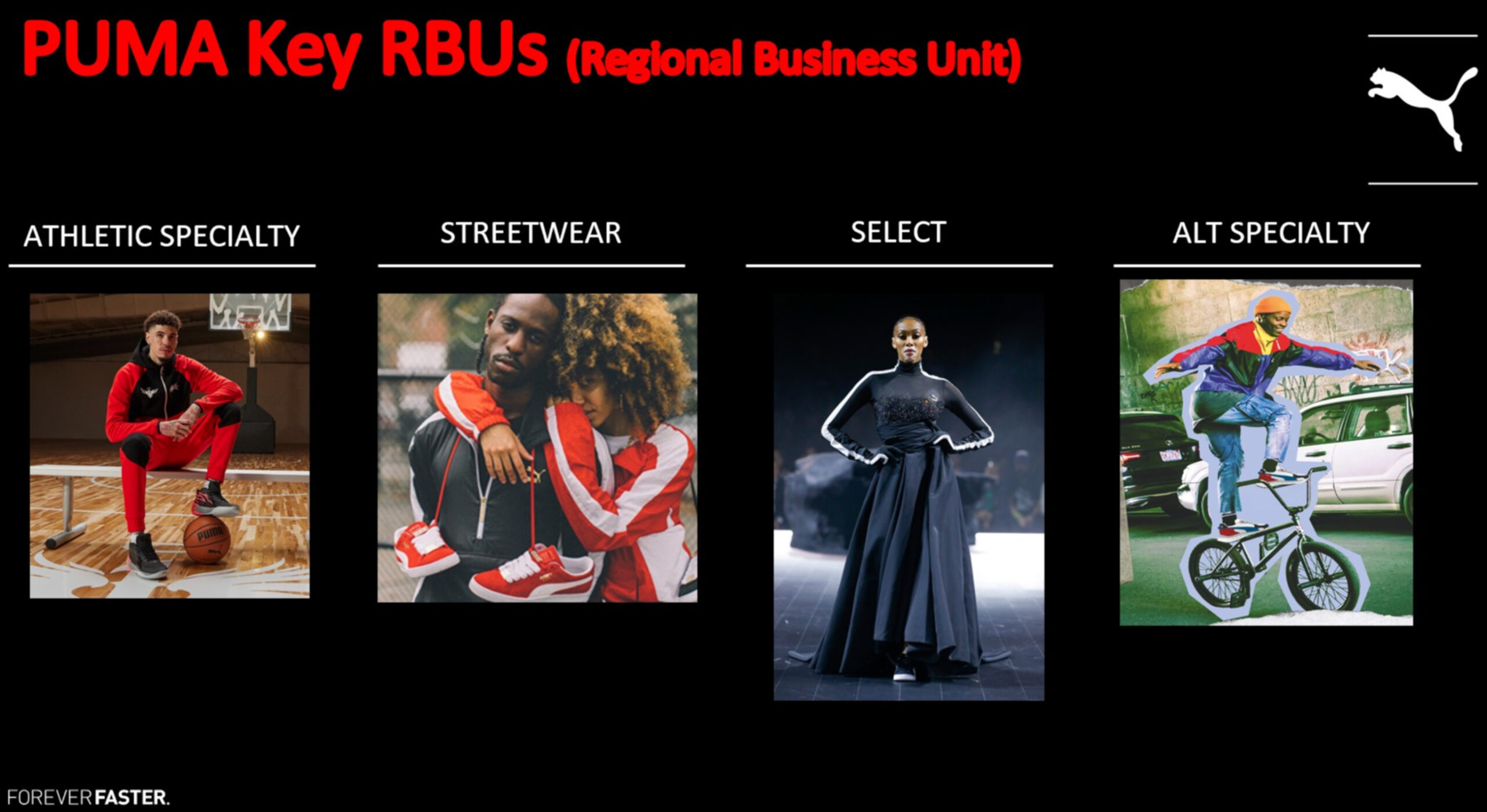
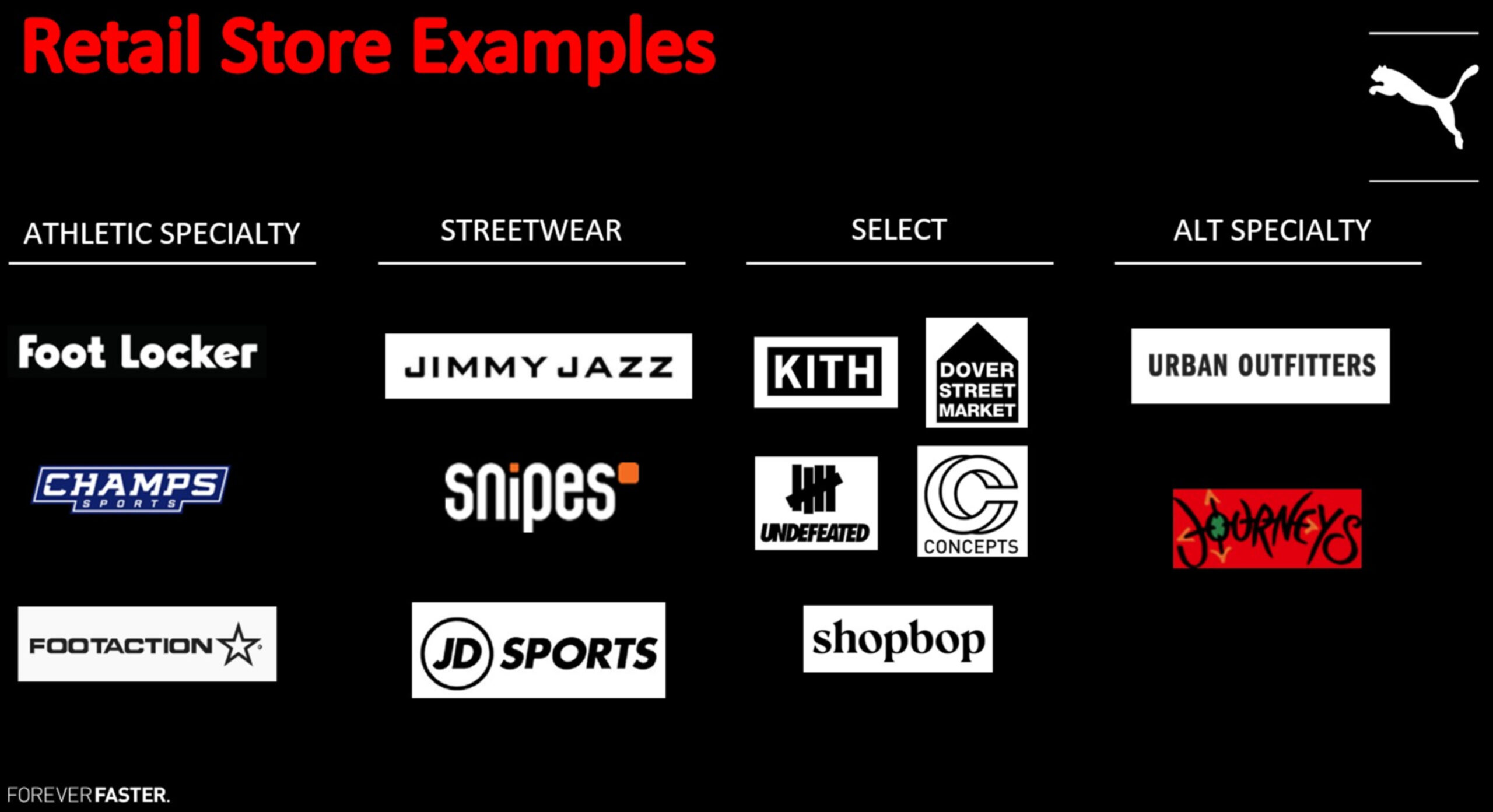
PUMA categorizes its merchandise into regional business units (RBUs). Four examples of their RBUs include Athletic Specialty, Alternative Specialty, Streetwear, and Select. Saltzman prepared Figures 3 and 4 for this study to help characterize these four examples and identify a few retailers that carry each of them. In a few words, these four example RBUs can also be described as follows:
- Athletic Specialty: Designers incorporate features that enhance sports performance to attract athletes of all skill levels; soccer cleats are a notable example.
- Alternative Specialty: Designers emphasize trendy aesthetic attributes to attract a youthful customer, offering styles like PUMA’s suede sneaker silhouette in an array of frequently updated colors at more affordable prices than other RBUs highlighted here.
- Streetwear: Designers blend sport-inspired aesthetic elements with fashionable details, such as matching sweatsuits in trendy colors and prints, to appeal to customers who wear PUMA as everyday wear rather than for athletic performance.
- Select: Designers create collectible, fashion-forward merchandise for discerning customers seeking exclusivity, using innovative silhouettes and celebrity collaborations. Example merchandise includes looks from the June Ambrose X PUMA runway show, such as the one shown in Figure 3.
Innovative designs and new styles are introduced in the Select RBU first, followed by a more exclusive distribution strategy. These designs are then tweaked for the other RBUs and, subsequently, for mass-market distribution, as discussed in further detail below.
Assignment
The scenario: You are a hopeful intern who found an opportunity at PUMA Select advertised online. You decide to apply, and as part of the application, you must demonstrate an understanding of the general sportswear market and how PUMA compares to its competitors.
Complete the following:
- First, gather information about the current size and the position of major brands in the sportswear market. Collect up-to-date numbers and statistics rather than focusing on aesthetic or performance differences, and avoid dwelling on personal preferences for one brand over another. Use and reference credible sources, such as Macrotrends, Statista, Fashion United, trade publications like The Business of Fashion and Footwear Magazine, brand websites, press releases, or other market intelligence resources.
- Next, analyze the changes in sportswear since this case study was written to determine the role PUMA currently plays in the market. For example, has PUMA narrowed the gap between its annual revenues and those of its competitors? Has PUMA increased its market capitalization or made any significant changes to its business operations? What does PUMA see as their key priorities for the near future?
- Finally, write a 1-page or less report on the findings from your research and analysis in steps one and two. Use your own words, use an elevated academic tone, and proofread thoroughly.
Building brand heat
Saltzman shared that a key priority at PUMA in 2025 was to “bring back brand heat,” a concept also described by PUMA as “elevating” during their 2024 year-end earnings conference call. During the call, PUMA outlined sport performance, authenticity, sustainability, innovation, and design newness as key differentiators for the coming year (PUMA, 2025b, p. 5). Alyssa Mann, writing for Footwear Magazine, quoted PUMA’s Chief Marketing Officer’s comments on the call: “Our focus on Gen Z and millennial consumers through culturally relevant collaborations has been transformative… When you combine limited-edition designs with creators who have authentic connections to their audiences, you create more than products—you create cultural moments” (2025, para. 3).
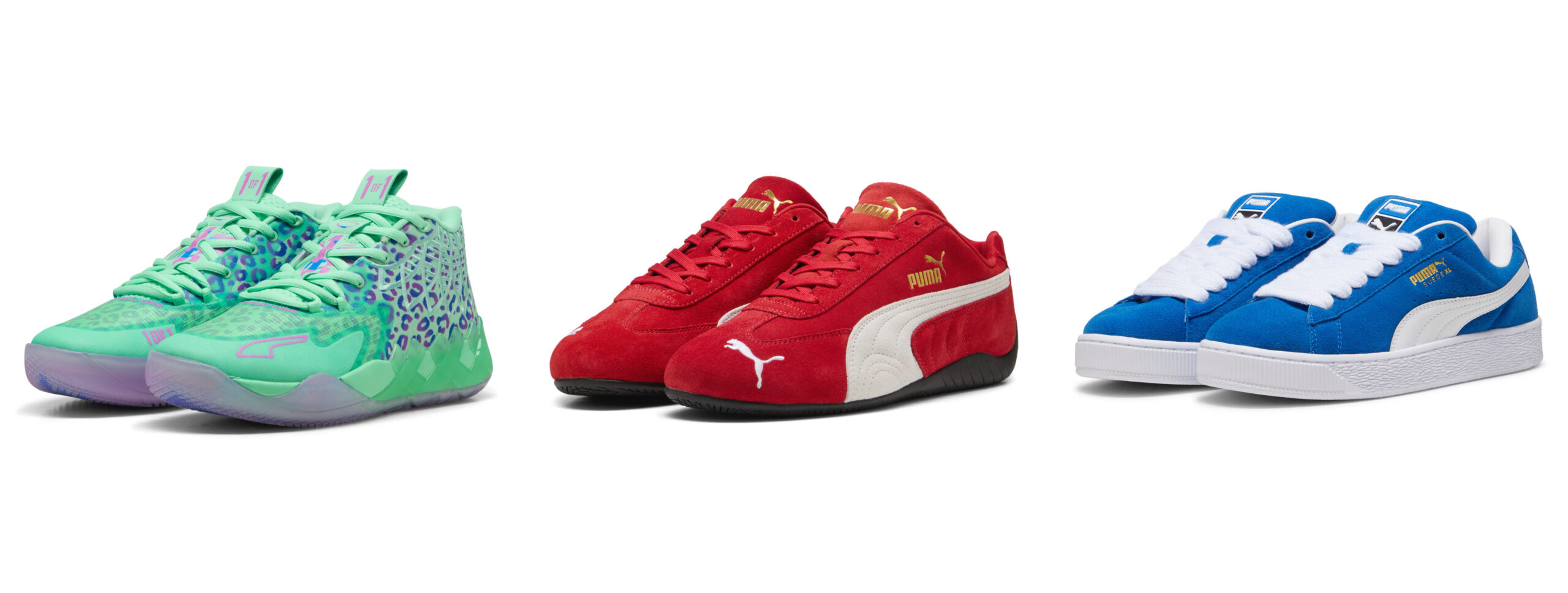
Saltzman offered further insight into why PUMA is well-positioned to create some brand heat. Many customers in the market for premium sneakers already have a closet filled with Nike Air Jordans, and their popularity, especially that of the Nike Air Force One, has been cooling off. The most discerning sneaker customers were starting to look for fresher and trendier options, leaving space for PUMA Select’s more innovative collections to thrive in an otherwise crowded market. Market analysts at StockX, an online sneaker reseller with in-house sales trends to draw from, echoed Saltzman in their Current Culture Index 2025. Nike and Air Jordan’s high-volume distribution, constant re-releases of existing styles, and mass marketing throughout 2023 and 2024 made them less desirable to the premium sneaker customers who were once loyal. The StockX report also predicted that scarcity would improve sell-through and attract customers seeking uniqueness (2025). StockX also reported a 10% growth in PUMA resales on their site in 2024 compared to 2023. They attributed this to three shoes in particular: the MB.01, the Speedcat, and the Suede XL, shown in Figure 5. For PUMA, Nike’s overexposure serves as a lesson in the importance of exclusivity when generating brand heat among sneakerheads.
Sneakerheads
Shrinking footwear sales at Nike could be an early indication of a shift in sneakerhead taste. Sneakerhead is a term coined to describe individuals who collect and are knowledgeable about sneakers. Sneakerheads are a frequently targeted but relatively niche market. Early academic attempts to characterize sneakerheads noted some unifying qualities, including nostalgia, an affinity for Nike’s Air Jordans, and a deep knowledge of the cultural history of sneakers. They tend to seek out rare sneakers and are willing to pay more for something unique, such as a collaboration with a celebrity. As a result, sneakerheads often tend to avoid mass-market retailers and their merchandise. Instead, they seek out specialty streetwear retailers owned by fellow sneaker enthusiasts with deep knowledge who convey authenticity (Matthews et al., 2021). Gaining traction with sneakerheads is vital to building brand heat in the premium sneaker market at PUMA, as sneakerheads tend to be more fashion-forward in their choices. By pushing the envelope of taste, sneakerheads can increase sales for merchandise across all price points.
Assignment
The scenario: You are an intern at America’s PUMA headquarters in Boston, Massachusetts. Your supervisor has noticed that you have an eye for trends and has asked you to prepare a short presentation for PUMA’s Select team, showcasing your research skills and understanding of the PUMA Select target market.
Complete the following:
- First, gather information and create a brief profile of the PUMA Select sneakerhead. You could create a slide, infographic, or another visual format of your choice. Your profile should include a variety of images of sneakerheads and sneakers, along with written text that describes the demographic, psychographic, geographic, and behavioral characteristics of the target audience. Use and reference credible sources for your statistics, such as Statista, Fashion United, trade publications like The Business of Fashion and Footwear Magazine, or other market intelligence resources.
- Next, apply your new knowledge of sneakerheads while researching upcoming sneaker trends they will covet in 12-18 months. Create a mood board using images that demonstrate one key trend you suggest PUMA Select pursue. You could create a slide, infographic, or another visual format of your choice. Remember to look beyond existing products when identifying inspiration for next year’s style, as sneakerheads tend to seek novelty. Instead, consider cultural influences such as movies, shows, celebrities, books, politics, music, travel, and social media, among others. Other helpful sources include trend forecasting publications such as WGSN, Pantone, Future Snoops, or Trend Hunter.
- Finally, you must present your work from steps one and two to PUMA’s Select team, including the visuals you created in each step. Use your own words, use an elevated academic tone, and proofread all materials thoroughly. Apply key concepts and vocabulary from this case study. Choose one of the following formats:
- (Option 1) A live 5-minute oral presentation with professionally presented visuals.
- (Option 2) An approximately 5-minute video of you delivering an oral presentation with professionally presented visuals.
The trickle-down effect
Saltzman explained during his interview that trends tend to trickle-down through the company. First, sneakerheads are offered innovative styles at PUMA’s highest price point for retailers like KITH, where customers are willing to spend more for something unique. If the style is successful with sneakerheads for several months, the design is eventually modified slightly to achieve a lower price point. The lower-priced version will be part of other RBUs, such as the Alternative Specialty, catering to trendy teens who shop at retailers like Urban Outfitters. Assuming the style remains successful, it is slightly modified again for a mass-market retailer like DSW, where it will become widely available at the lowest price point PUMA offers. The trickle-down from Select to mass market is not guaranteed and can take one to two years, depending on the style. Sales results are not available by RBU, but Saltzman shared that the styles that go to mass market stores “pay salaries and keep the lights on in the showroom, but [Select] is what keeps people coming in.” This trickle-down theory is not the only explanation for trend diffusion, but it has been battle tested for more than a century in fashion. The theory is usually attributed to Georg Simmel’s Fashion, initially written in 1904 and later reprinted. In short, Simmel theorized that “the elite initiates a fashion and, when the mass imitates it in an effort to obliterate the external distinctions of class, abandons it for a newer mode. . .” (1957, p. 1). Therefore, to keep the sneakerhead customer excited, exclusivity and control over new and innovative styles are cornerstones of PUMA Select’s premium fashion-forward appeal. Saltzman explained how this trickle-down theory applies to PUMA Select’s real-world distribution decisions:
The bottom line is that we want the right shoe for the right store. Some mall-based stores want everything, even Select, but we tell them no; you don’t have that PUMA Select customer… We don’t want to muddy our waters just for a sale.
To elaborate, Saltzman offered an analogy. Allowing retailers to sell the Select RBU in their stores is akin to letting them into a gated community. However, access to Select is merely the first gate. There is also what PUMA calls Cream merchandise within the Select RBU. Cream is an even more premium and exclusive subset of Select merchandise; therefore, it is behind yet another gate where access is even more tightly controlled. Examples of Cream products have included special versions of new shoe styles, as well as collaborations with notable figures such as June Ambrose, KidSuper, Rihanna, and A$AP Rocky. Globally, there are 75 retailers with access to sell Cream in their stores, with only 10 of these based in the United States. Sneakerheads trust these exclusive retailers, and PUMA refers to them as Community Doors.
Lead merchandisers control access to Cream, and during collection previews at PUMA’s German headquarters, they pre-determine the retailers and quantities to send. Tight control and limited distribution lead to Cream selling out quickly, if not immediately. Coveted but unavailable, these products may also find their way to the secondary market on websites like StockX, GOAT, Kixify, or eBay, where collectors are often willing to pay far more than the retail price for limited-edition sneakers. Sneakerhead resale buzz communicates value to fashion enthusiasts, thereby building brand heat for all of PUMA’s other merchandise offered at all price points.
Selective allocation
Making accurate predictions about what merchandise will sell, how much to make, and which stores will sell it are all crucial decisions for any consumer goods company. The term allocation in this context refers to the process of determining how to strategically distribute merchandise to individual stores in a manner that maximizes profit and reduces the need to discount merchandise at the end of the season. For low-end and middle-market merchandise, conventional wisdom suggests that a fashion merchandiser should aim to allocate exactly the correct number of units to meet customer demand perfectly. This way, every customer would pay the full price for every unit, thereby maximizing profit. However, sneakerhead customers defy some of this conventional wisdom, and the best allocation strategies are less intuitive for them: send less, sell out quickly, be hard to find, and build brand heat through resale platforms like StockX. Scarcity, though counterintuitive, has served many brands very well, from Hermès to Ferrari, a PUMA Select collaborator. Enzo Ferrari famously promised that his namesake company would consistently deliver one car less than the market demands, and the brand has successfully stuck with this philosophy through the decades since. Similar to Nike throughout 2023 and 2024, over-availability can quickly catapult an innovative style into the mainstream and ultimately send a sneakerhead searching for something else, which is precisely what PUMA Select must avoid.
Assignment
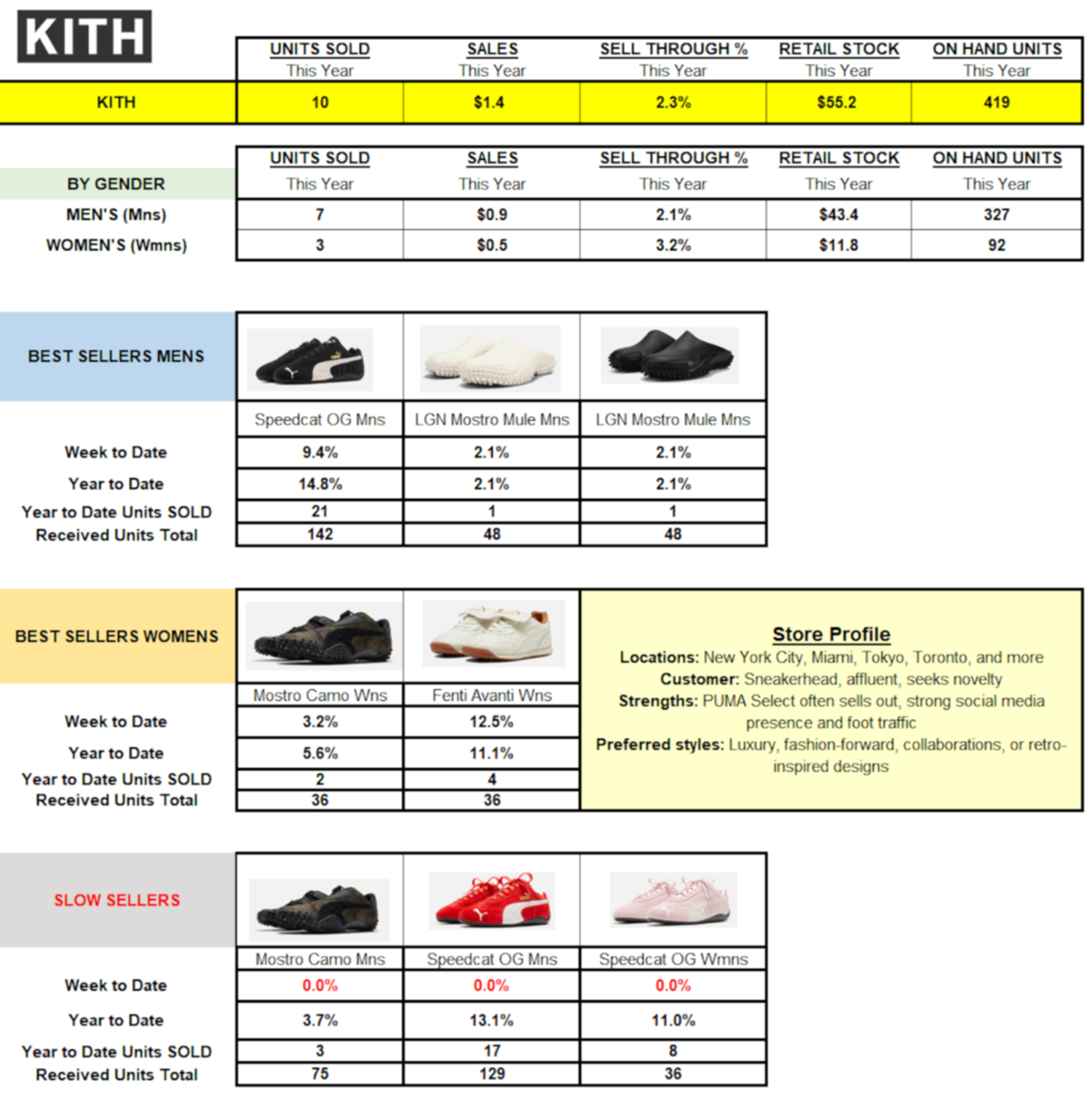
The scenario: Saltzman was so impressed by your trend report during your internship that he hired you to work full-time as a Junior Account Executive with him in the Select showroom in downtown New York City. As your first project, he has asked for your help in allocating 1,000 units of Cream sneakers among three Community Door retailers: Extra Butter, CNCPTS, and WISH Atlanta. There are eight styles to allocate in total, five for men and three for women. The streetwear retailer KITH received all eight styles last week, and Saltzman prepared the simplified weekly sales report shown in Figure 8. He also added a brief store profile to help you get acquainted with his largest retail account. Before you start, he reminds you that sales reports and local preferences should always inform your decision-making. After all, it has only been a week, and slow sellers can become bestsellers in the right store.
Complete the following:
- First, research the three Community Door retailers, Extra Butter, CNCPTS, and WISH Atlanta. Create a bullet-point store profile for each to help you understand the local market. For guidance, refer to the example provided in the yellow inset box in Figure 8.
- Next, apply your research findings and allocate a quantity of sneakers to each store. You must record your choices in a table format; a starter template with the number of units to allocate for each style is provided in Table 1. There can be no leftover sneakers after you have allocated them, and every retailer must get at least one style.
- Finally, you must explain your allocation decisions to Saltzman using the materials you produced in steps one and two. Use your own words, use an elevated academic tone, and proofread all materials thoroughly. Apply key concepts and vocabulary from this case study. Choose one of the following formats:
- (Option 1) A two-page written document. On the first page, include all materials produced in steps one and two. On the second page, write a 2-3 paragraph explanation of your allocation decisions.
- (Option 2) An approximately 3-minute video. You must display all materials produced in steps one and two in the video and explain your allocation decisions verbally.
| Item | Extra Butter | CNCPTS | WISH | Total Units Available |
|---|---|---|---|---|
| Speedcat OG Men’s – Black | 200 | |||
| Speedcat OG Men’s – Red | 150 | |||
| Speedcat OG Women’s – Pink | 125 | |||
| Mostro Camo Men’s | 150 | |||
| Mostro Camo Women’s | 150 | |||
| LGN Mostro Mule Men’s – White | 75 | |||
| LGN Mostro Mule Men’s – Black | 75 | |||
| Fenty Avanti Women’s | 75 | |||
| Total for Each Store | 1000 |
Glossary
Allocation: The process of strategically distributing merchandise to individual stores in a manner that maximizes profit.
Brand Heat: An expression used by Scott Saltzman during his June 2025 interview to describe customer excitement, intrigue, and brand loyalty, ultimately leading to increased sales at PUMA.
Cream: A label PUMA employees use in-house to designate a special selection of merchandise within the Select RBU. Cream is the most expensive, rare, and tightly controlled merchandise the brand offers.
Distribution strategy: The pre-determined methods brands use to get their products to the final customer through retail channels.
RBU (regional business unit): A phrase used at PUMA to broadly describe different categories of merchandise, for example, Athletic Specialty, Alternative Specialty, Streetwear, and Select.
Select: The name used at PUMA to describe their most innovative and high-end RBU.
Acknowledgments
Thank you to Scott Saltzman for the interview, images, assistance with assignment design, and for reviewing a draft of this case study. Thank you to Susan Watkins for the thoughtful revisions and copy editing.
This research was funded by a State University of New York Innovative Instruction Technology Grant (IITG) administered through the Fashion Institute of Technology (FIT) and in partnership with the State University of New York at Oneonta. The Institutional Review Board at FIT deemed this research exempt from further oversight on October 9, 2024, and there are no conflicts of interest to report.
References
Davies, K. (2025a, January 14). Global revenue of adidas, Nike and Puma from 2006 to 2023. Statista. https://www.statista.com/statistics/269599/net-sales-of-adidas-and-puma-worldwide/
Davies, K. (2025b, March 19). Footwear revenue of Nike, adidas & Puma 2010-2024. Statista. https://www.statista.com/statistics/278834/revenue-nike-adidas-puma-footwear-segment/
Deckers Brands. (2025, May 22). Reports Fourth Quarter and Full Fiscal Year 2025 Financial Results. https://ir.deckers.com/news-events/press-releases/press-release/2025/Deckers-Brands-Reports-Fourth-Quarter-and-Full-Fiscal-Year-2025-Financial-Results/default.aspx
Mann, A. J. (2025, April 12). Puma Footwear Hits €4.73B in 2024 with 13% Growth. Footwear Magazine. https://footwearmagazine.com/puma-footwear-hits-e4-73b-in-2024-with-13-growth/
Matthews, D., Cryer-Coupet, Q., & Degirmencioglu, N. (2021). I wear, therefore I am: Investigating sneakerhead culture, social identity, and brand preference among men. Fashion and Textiles, 8(1), 1–13. https://doi.org/10.1186/s40691-020-00228-3
On. (2025, March 2). On Announces Fourth Quarter and Full Year Results, and the Filing of its Annual Report on Form 20-F for 2024. https://investors.on-running.com/financials-and-filings/financial-releases/news-details/2025/On-Announces-Fourth-Quarter-and-Full-Year-Results-and-the-Filing-of-its-Annual-Report-on-Form-20-F-for-2024/default.aspx
PUMA. (2025a, March 12). PUMA grows currency-adjusted sales 4.4% in 2024 and provides outlook for 2025. https://about.puma.com/en/newsroom/corporate-news/2025/12-03-2025-puma-grows-currency-adjusted-sales-44-2024-and-provides
PUMA. (2025b, March 12). Q4/FY 2024 Earnings Call. https://about.puma.com/sites/default/files/financial-report/2024/puma_earnings-call_q4_fy-2024_website.pdf
Simmel, G. (1957). Fashion. American Journal of Sociology, 62(6), 541–558.
StockX. (2025, January). Big Facts: Current Culture Index 2025. https://stockx.com/about/sx-market-insights/big-facts-current-culture-index-2025/
Takanashi, L. (2025, May 30). Why Hoka Is Slowing and On Keeps Growing. The Business of Fashion. https://www.businessoffashion.com/articles/retail/hoka-slowdown-on-growth-explained/